



Local SEO Strategy: The 90-Day Plan to Get Your Business on Page 1
A phased, 90-day local SEO roadmap with real case studies, budget breakdowns, and the exact process I use to rank small businesses in Google Maps and local search.
TL;DR Too Long; Didn't Read
Local SEO takes about 90 days of consistent work to produce meaningful results. This guide breaks it into 5 phases: audit your current presence, lock down your Google Business Profile and citations, build local content and authority, then expand into advanced tactics like service area business strategy and AI search optimization. No shortcuts, just the fundamentals executed well.

On this page
If you’re running a local business and you’re not showing up when someone searches “plumber near me” or “best dentist in [your city],” you’re leaving money on the table every single day.
I’ve spent 15 years helping businesses get found online. And I can tell you that local SEO has changed more in the past two years than in the previous ten. Between AI-powered search results, Google’s constant algorithmlocal SEO has changed more in the past two years than in the previous ten. Between AI-powered search results, Google’s constant algorithm updates, and shifting consumer behavior, the tactics that worked in 2023 might actually hurt you today.
Here’s the thing: local SEO isn’t complicated. It requires consistency, attention to detail, and knowing which activities actually move the needle. What most guides get wrong is dumping a list of tactics without telling you what to do first, what to do second, and what can wait.
This guide is different. I’m giving you a phased 90-day plan, the same process I use with clients. You’ll know exactly what to do each week, with real case studies from businesses I’ve actually worked with. No theory. No fluff. Just what works.
Free Download: 90-Day Local SEO Checklist
The same phase-by-phase action plan I use with clients. 100+ checkbox items across 5 phases.
What Is Local SEO and Why Does It Matter More in 2026?
Local SEO is the practice of optimizing your online presence so you show up when people in your area search for what you offer. When someone types “emergency AC repair Denver” or asks their phone “where can I get my brakes done nearby,” local SEO determines whether your business appears or gets buried.
According to Backlinko’s research, 46% of all Google searches have local intent, and 42% of searchers click on the local pack results. If you’re not in that pack, you’re fighting for scraps.
What’s Changed in 2026
AI Overviews are everywhere, but not for local. Google’s AI-generated summaries now appear on about 13% of all searches. But here’s the good news: LocalFalcon’s data shows only 0.14% of local keyword searches trigger AI Overviews. Google still surfaces the local map pack prominently. For local businesses, this is actually an advantage.
“Near me” searches have matured. People don’t even type “near me” anymore. Google assumes local intent based on dozens of signals. Industry data shows 1.5 billion “near me” searches still happen every month, but Google now handles local intent even without those words.
Review velocity matters more than ever. According to BrightLocal’s 2025 Local Search Ranking Factors study, reviews now account for roughly 20% of local pack ranking signals, up from 16% in 2023. A business getting consistent new reviews will outrank one with more total reviews but no recent activity.
Mobile dominates. Research shows that 84% of local searches happen on mobile devices, and 88% of consumers who do a local search on their phone visit or call a store within a day.
Local SEO vs. Traditional SEO
Traditional SEO focuses on ranking nationally for broad keywords. Local SEO targets people searching in a specific geographic area. Different ranking factors, different strategy, different tools entirely.
If your customers come from your city or region, local SEO is what matters. National rankings are nice, but they don’t put local customers through your door.
The Three Pillars of Local Search Rankings
Google’s local algorithm rolls up into three core pillars. Understanding these will help you prioritize your effort.
Relevance
Does your business match what the searcher is looking for? This comes down to your business categories, the content on your website, and the keywords in your listings. A search for “emergency plumber” should return businesses that explicitly offer emergency plumbing services, not general plumbers.
Distance
How close is your business to the searcher? You can’t change your location, but you can influence this through service area settings, hyper-local content, and location-specific landing pages.
Prominence
How well-known and trusted is your business online? Reviews, citations, backlinks, press mentions, social signals. Strong branding amplifies every one of these.
Here’s what I’ve learned after years of testing: most businesses focus too much on relevance (stuffing keywords everywhere) and not enough on prominence. You can have the most perfectly optimized Google Business Profile in the world. But if you have few reviews and your competitor has hundreds, you’re probably not winning.
A balanced local SEO strategy addresses all three pillars simultaneously. The 90-day plan below is designed to do exactly that.
The Three Ranking Surfaces
Your business competes on three different surfaces in Google’s search results:
- The Map Pack (the top 3 local results with the map): Dominated by GBP signals, reviews, and proximity.
- Organic Results (the traditional blue links below): Dominated by your website’s content, authority, and technical SEO.
- AI Overviews (Google’s AI-generated summaries): Dominated by authoritative, well-structured content that directly answers questions.
Each surface rewards different signals. A complete local SEO strategy targets all three.
Phase 1: Audit Your Current Local Presence (Week 1-2)
Before you build anything, you need to know where you stand. Skipping the audit is like starting a road trip without checking your gas gauge.
Run a Local SEO Audit
Pull up these items and document what you find:
Google Business Profile: Is it claimed and verified? Are all fields complete? When was the last post? How many reviews do you have, and what’s the average rating?
Website: Does it load fast on mobile? Does every page have your business name, address, and phone number? Do you have dedicated pages for each service and location you serve?
Citations: Search your business name in quotes on Google. Are the name, address, and phone number consistent across all listings? Note any inconsistencies.
Reviews: What’s your average rating? How many reviews have you received in the past 3 months? Are you responding to all of them?
Rankings: Search your top 5 target keywords from your business location. Where do you appear? Are you in the map pack or below it?
Competitor Analysis
Search your top 3 keywords and study who shows up in the map pack. For each competitor, note their review count, categories, posting frequency, and what their website looks like. You’re looking for gaps you can exploit and strengths you need to match.
Identify Your Quick Wins
After the audit, sort your findings into three buckets:
- Fix now (takes minutes, immediate impact): Missing GBP fields, wrong phone number, no business hours
- Fix this month (takes hours, significant impact): NAP inconsistencies, missing citations, incomplete website pages
- Build over time (takes months, compounding impact): Review velocity, content creation, link building
This triage prevents overwhelm. Most businesses have 5 to 10 quick wins sitting right in front of them.
Phase 2: Lock Down Your Foundation (Week 3-4)
This is where the real work begins. Your Google Business Profile and your technical setup form the base everything else builds on.
Google Business Profile: The Single Most Important Asset
Your Google Business Profile influences roughly 40% of your local pack ranking ability. Getting this right is non-negotiable.
Complete every field. Industry benchmarks show that businesses with complete profiles get 7x more clicks. Every blank field is a missed signal.
Business name: Use your actual business name. No keyword stuffing. “Joe’s Plumbing” is correct. “Joe’s Plumbing | Emergency Plumber Denver | 24/7” will get you suspended.
Primary category: Choose the most specific category that describes your main service. “Personal Injury Attorney” beats “Lawyer.” See our guide to GBP categories for the full list.
Secondary categories: Add every relevant one. A dental office might add “Cosmetic Dentist,” “Emergency Dental Service,” and “Teeth Whitening Service.”
Business description: You get 750 characters. Use them all. Include your primary services, service area, what makes you different, and a natural mention of your main keywords.
Services and products: Fill these out completely. Each service can have its own description. This is prime real estate for keyword targeting.
Photos and Videos
According to BrightLocal’s GBP Insights Study, businesses with more than 100 photos get 520% more calls than average. Even getting to 10+ quality photos makes a noticeable difference.
Post photos of your team, your work, your location (interior and exterior). For service businesses, before-and-after photos perform exceptionally well.
Video is overlooked. A 30-second intro video of the business owner explaining what you do builds trust instantly.
Google Posts: Consistency Over Perfection
Publish Google Posts weekly. They expire after 7 days, so consistent posting keeps your profile active. Topics that work: recent projects, seasonal offers, community involvement, helpful tips.
NAP Consistency
Your business name, address, and phone number (NAP) must be identical everywhere. I mean identical. “123 Main St” and “123 Main Street” are different to citation databases. These inconsistencies confuse Google and dilute your authority.
Create a master NAP document and reference it every time you create or update a listing:
- Business Name (exact legal formatting)
- Address (exact formatting, including suite numbers)
- Phone Number (one format everywhere)
- Website URL (with or without www, http vs https)
For a deeper dive on citation building, read our local citation building guide.
Local Business Schema Markup
Schema markup is code you add to your website that tells search engines exactly what your business does. For local businesses, you need LocalBusiness schema with:
- Business name, address, phone
- Operating hours
- Service area
- Geo-coordinates
- Reviews aggregate
This is one of those things most small business owners skip because it sounds technical. But it directly helps Google understand your business, and it can trigger rich results (stars, hours, phone number) in search.
If you’re on a platform like WordPress or Squarespace, plugins handle this for you. For custom sites, your developer can implement it in under an hour.
Technical SEO Foundations
Your website needs to support your local SEO strategy:
- Mobile-first design: 84% of local searches happen on phones. If your site is slow or frustrating on mobile, you’re losing the majority of potential customers.
- Core Web Vitals: Google’s page experience signals (loading speed, interactivity, visual stability) impact rankings. Test with PageSpeed Insights.
- Click-to-call buttons: Your phone number should be tappable on mobile. Make it prominent.
- SSL certificate: HTTPS is table stakes. If you don’t have it, fix that first.
For more on technical foundations, see our technical SEO guide.
Phase 3: Build Your Local Content Engine (Month 2)
With your foundation locked down, it’s time to create the content that targets your keywords and serves your audience.
Local Keyword Research
Start by listing every service you offer and every area you serve. Then create keyword combinations:
- [Service] + [City]: “roof repair Aurora”
- [Service] + [Neighborhood]: “plumber Capitol Hill Denver”
- [Service] + near me: “emergency dentist near me”
- [Modifier] + [Service] + [Location]: “affordable lawn care Lakewood”
Don’t guess at search volume. Use tools like Semrush, Ahrefs, or Google Keyword Planner to validate which combinations people actually search. For more on this process, see our keyword research guide.
Map every keyword to a specific page on your website. This prevents cannibalization (multiple pages competing for the same term) and ensures you’re not missing obvious opportunities.
Location Pages That Actually Rank
If you serve multiple areas, each location page needs:
- Unique content (500+ words minimum)
- Embedded Google Map centered on that location
- Testimonials from customers in that area
- Local landmarks or references that show genuine knowledge
- NAP information specific to that location
Google can detect when you’ve just copied 50 identical pages with city names swapped. Those don’t rank. Put in the work to make each page actually useful to someone in that area.
Real Result: Wedding DJ Colorado
47 location pages. $6,500 investment. From invisible (position 20+) to #1 across a 100-mile radius in 6 days. This is what hyper-local content strategy looks like when done right. Full case study →
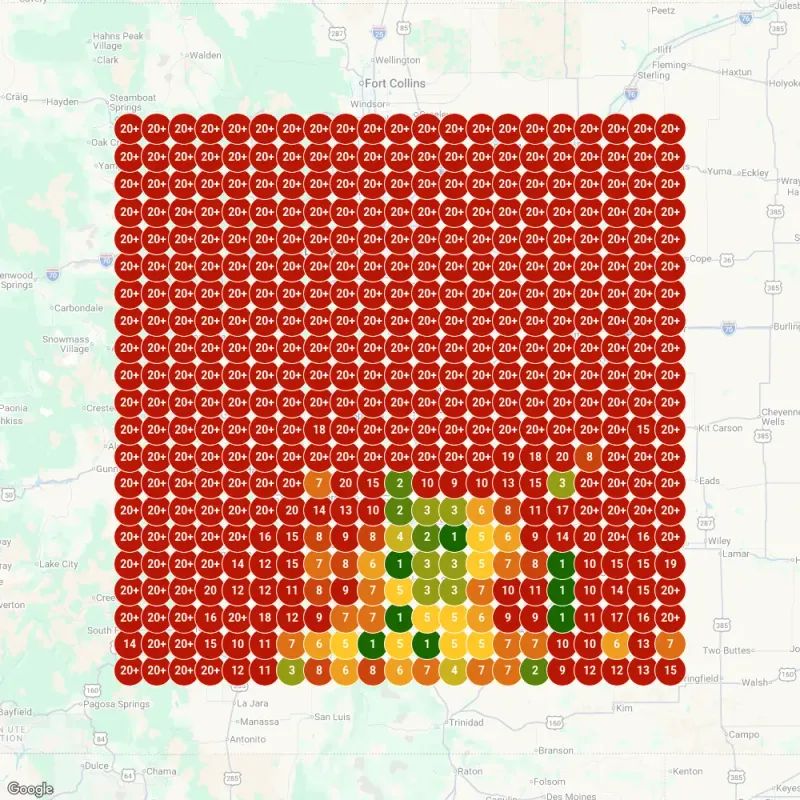
The heatmap above shows the ranking coverage after we built 47 targeted location pages for a wedding DJ in Pueblo. Each green pin represents a #1 ranking. That’s the power of hyper-local content done right.
Local Content Beyond Location Pages
Location pages target “service + city” keywords. But you also need content that targets informational queries your customers are asking:
- “How much does [service] cost in [city]?”
- “Best [service] for [specific need]”
- “When to [hire/call] a [service provider]”
These blog posts build topical authority and give Google more signals about your expertise. They also capture people earlier in the buying process, before they’re ready to pick up the phone.
Video Content for Local SEO
Most local businesses ignore video entirely. That’s an opportunity. A simple YouTube video answering “How much does [service] cost in [city]?” can rank in both YouTube search and Google’s video carousel.
You don’t need production quality. A smartphone, good lighting, and actually knowing your stuff is enough. Aim for 3 to 5 minute videos answering one specific question each.
Phase 4: Build Local Authority (Month 2-3)
Content gets you noticed. Authority gets you trusted. This phase focuses on the signals that tell Google (and customers) your business is legitimate and respected.
Local Citation Building
A citation is any online mention of your business name, address, and phone number. Focus on 40 to 80 high-quality citations before worrying about volume:
Tier 1 (must-have): Google Business Profile, Apple Maps, Bing Places, Facebook, Yelp, industry-specific directories (Healthgrades for medical, Avvo for legal, HomeAdvisor for home services)
Tier 2 (important): Yellow Pages, BBB, local Chamber of Commerce, city-specific directories
Tier 3 (data aggregators): Neustar Localeze, Foursquare, Data Axle. These feed hundreds of smaller directories automatically. Submit to the aggregators and your information cascades downstream.
Cleaning up existing NAP inconsistencies often produces faster ranking improvements than building new citations. Audit quarterly using BrightLocal or Whitespark.
A word of caution on Yext: their “PowerListings” model means your listings disappear if you cancel the subscription. I prefer building owned citations manually on the most important directories, even if it takes longer.
Local Link Building
Backlinks remain a significant ranking factor. For local businesses, the best links come from your own community:
- Sponsorships: Little league teams, charity runs, community events. These often come with a website link.
- Chamber of Commerce: Membership includes a directory listing with a backlink.
- Local news and blogs: Pitch story ideas, offer expert commentary, sponsor local journalism.
- Vendor and partner relationships: If you’re a preferred contractor for a property management company, ask for a link on their vendor page.
For more tactics, see our link building guide.
The quality hierarchy: One link from your local newspaper is worth more than 50 links from random directories. Prioritize links from local news, .edu, .gov sites, then local businesses and associations.
Review Generation System
Reviews influence rankings (20% of local pack signals) and conversions. The businesses getting steady reviews have systematized the ask:
Follow-up emails or texts: Send a review request 24 to 48 hours after service. Include a direct link to your Google review page.
In-person asks: Train your team: “We’d really appreciate a Google review if you have a minute.” Simple, direct, effective.
Review cards: Physical cards with QR codes linking to your review page. Hand them out after completing a job.
Respond to every review, positive or negative, within 48 hours. How you handle negative reviews tells potential customers a lot about your business. A thoughtful response to a one-star review can actually improve conversion.
Never fake reviews or pay for them. Google’s detection has improved dramatically. Getting caught leads to penalties that tank your visibility.
Social Profiles as Local Signals
Social media doesn’t directly rank you in local search, but it sends supporting signals. Active profiles on Facebook, Instagram, and LinkedIn confirm your business is real and engaged. Google cross-references social profiles with your GBP listing.
At minimum, keep your profiles updated with consistent NAP information and post regularly. For local businesses, community engagement posts (sponsorships, events, customer spotlights) perform well.
Phase 5: Advanced Tactics (Month 3+)
Once the fundamentals are running, these advanced tactics separate businesses that rank from businesses that dominate.
Service Area Business Strategy (No Storefront? No Problem)
This is the biggest blind spot in local SEO advice. Every guide assumes you have a physical storefront. But plumbers, HVAC technicians, consultants, cleaning companies, mobile mechanics, and dozens of other business types serve customers at their locations, not their own.
If you’re a service area business (SAB), the strategy shifts:
GBP setup: Set your business as a service area business in Google. Hide your home address. Define the specific areas you serve.
No walk-in traffic means content carries more weight. Without a storefront for Google to pin on the map, your website content and citations do the heavy lifting to prove you serve that area.
Service area pages are your location pages. Instead of optimizing for one address, create dedicated pages for each city or zone you serve. Each page needs unique content about serving that area.
Reviews still mention locations. Encourage customers to mention their city in reviews: “Great service in Arvada” tells Google you serve that area even without a physical presence there.
Real Result: Sealwise Epoxy (Service Area Business)
A Colorado Springs epoxy company with no storefront. From invisible online to #1 across a 25-mile radius. $26,240 in tracked revenue within 60 days of going live. Full case study →
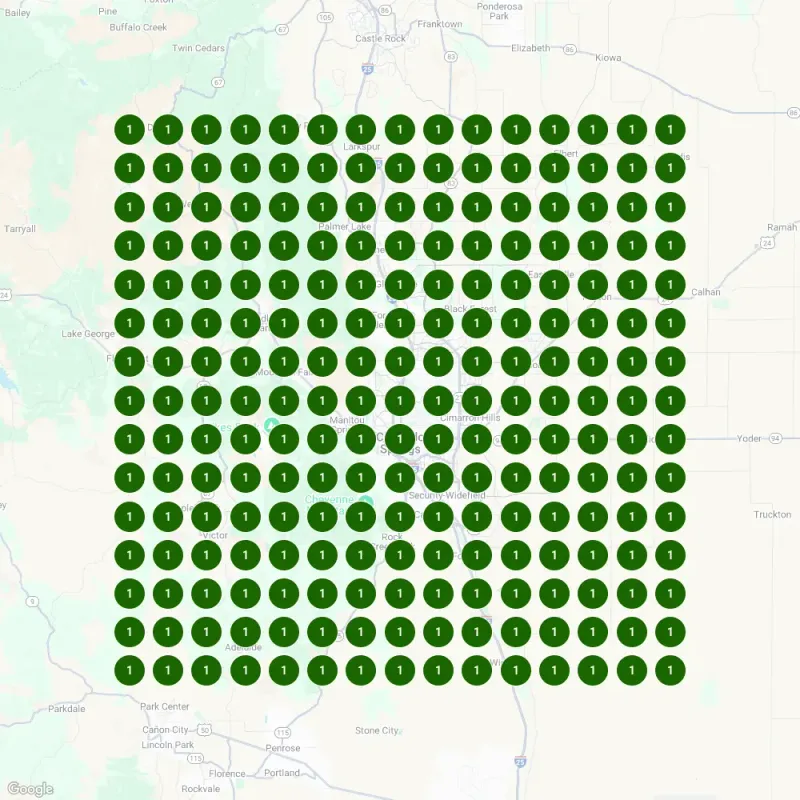
The GeoGrid above shows Sealwise Epoxy’s ranking coverage. Every green square is a #1 position. This is a service area business with no walk-in location, ranking across 25 miles through content, citations, and a strong review profile.
Multi-Location Local SEO
If you have multiple physical locations, each one needs its own Google Business Profile, its own set of citations, its own location page on your website, and (ideally) its own stream of reviews. Centralizing everything under one listing doesn’t work.
The challenge is making each location’s content unique without drifting from your brand. Template pages with swapped city names get ignored by Google. Each location needs its own content, referencing local landmarks, team members at that branch, and testimonials from customers in that area.
AI Search and Voice Optimization
AI Optimization is the newest layer of local SEO. AI Overviews appear on only 0.14% of local searches today, but being cited as a source in AI-generated answers is starting to matter.
To position your content for AI citation:
- Structure content as clear, direct answers to specific questions
- Use FAQ schema markup on your website
- Build topical authority through deep content clusters
- Ensure your GBP has accurate, complete information (voice assistants pull this data)
Real Result: WCG CPAs & Advisors
991 keywords in the top 3. 175 AI Overview citations. This Colorado Springs CPA firm became the source Google’s AI references for tax and business formation questions. Full case study →
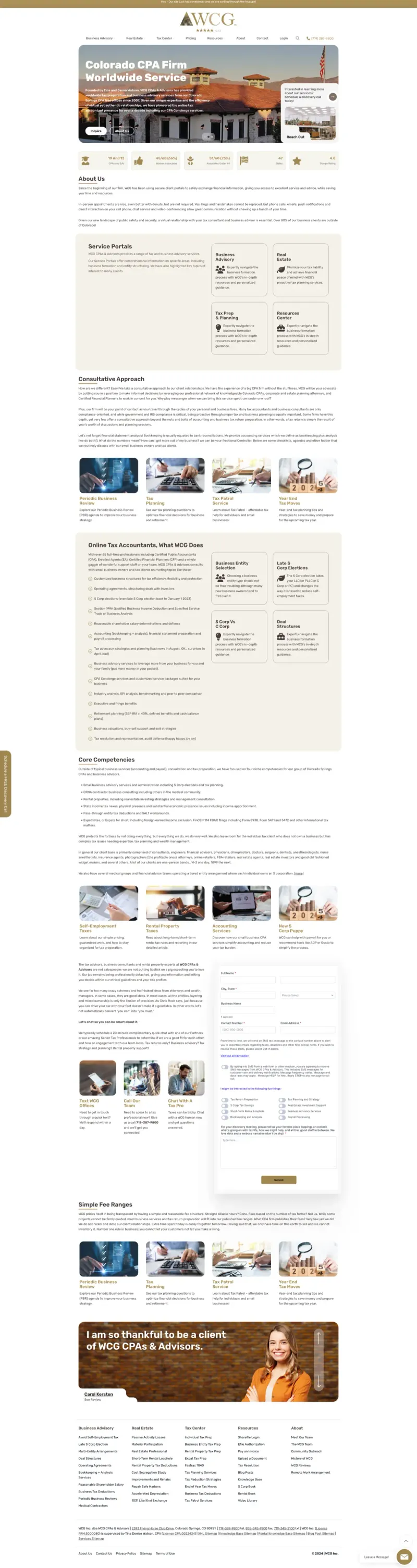
The WCG CPAs project shows what happens when you pair solid website architecture with deep, authoritative content. Google’s AI doesn’t just rank this site. It cites it as the source.
Voice search follows similar principles. Voice queries tend to be conversational and question-based: “Hey Google, who’s the best plumber near me?” Target question-based keywords in your content and FAQ sections.
Spam Fighting: Protecting Your Rankings
A tactic nobody talks about: reporting competitor spam. Businesses stuffing keywords into their GBP names, using fake addresses, or running review schemes can outrank you unfairly.
If you spot competitors violating Google’s guidelines, report them through the Google Business Profile “Suggest an edit” feature or the Business Redressal Complaint Form. Google doesn’t always act quickly, but persistent reporting does work over time. This is a legitimate defensive strategy.
How to Measure Local SEO Results
You can’t improve what you don’t measure. But too many businesses track vanity metrics while ignoring the numbers that actually matter.
The KPIs That Actually Matter
Primary (track weekly):
- Map pack rankings for your top 10 keywords
- Google Business Profile views, calls, and direction requests
- Phone calls and form submissions from organic traffic
- Review count and velocity (new reviews per month)
Secondary (track monthly):
- Organic traffic to location pages
- Citation accuracy score
- New backlinks acquired
- Average review rating
Connecting Local SEO to Revenue
This is where most guides stop, and it’s exactly where you need to keep going. Rankings and traffic are meaningless if they don’t turn into revenue.
Set up call tracking (CallRail, WhatConverts, or similar) so you can attribute phone calls to specific search queries and landing pages. Track form submissions with UTM parameters. If you use a CRM, connect your web leads to closed deals.
The formula is straightforward: impressions > clicks > calls/forms > quotes > closed deals. When you can trace a $5,000 job back to a “plumber near me” search, the ROI of local SEO becomes undeniable.
Local SEO by Industry: What Changes
The core principles apply everywhere, but every industry has its own quirks. Here’s what shifts based on your business type.
Home Services (Plumbing, HVAC, Electrical, Roofing)
Home services businesses are almost always service area businesses, so the SAB strategy above is critical. Emergency keywords (“emergency plumber,” “24/7 AC repair”) carry high intent and convert fast. Before-and-after photos are your best content asset. Reviews mentioning specific services and locations carry extra weight.
For a comprehensive playbook, see our home services marketing guide.
Healthcare and Dental
Healthcare local SEO has unique constraints. HIPAA compliance limits what you can say about patients, even in case studies. Provider-specific pages (one per doctor) with schema markup for each physician outperform generic practice pages. Review management requires sensitivity around patient privacy.
Real Result: TriumpHealth (Healthcare)
1,004 organic keywords. 66% traffic growth. 13 AI Overview citations with #1 rankings for every single one. Healthcare SEO works when you combine compliance with strategy. Full case study →
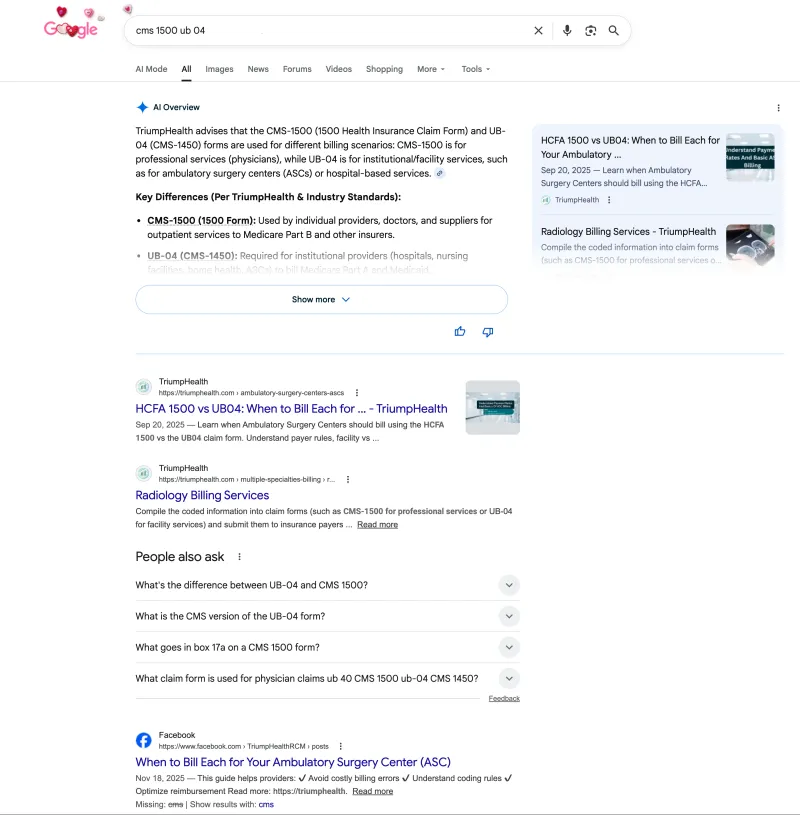
The screenshot above shows Google’s AI Overview directly citing TriumpHealth as the source for medical billing queries. Every one of their 13 captured AI citations also ranks #1 in traditional organic results.
Restaurants and Hospitality
Menu schema markup, food ordering integration, and photo quality are disproportionately important. Reviews mentioning specific dishes or experiences help Google understand what you offer. Google Posts with specials and events drive direct engagement.
Professional Services (Law, Accounting, Consulting)
Topical authority matters more here than in any other category. In-depth content that demonstrates expertise (guides, FAQs, case studies) builds the trust signals Google values for YMYL (Your Money or Your Life) topics. Practice area pages function like service pages for other industries.
Budget and Timeline Reality Check
I’m going to be direct about something most guides avoid: what this actually costs and how long it takes.
What Different Budgets Buy
$500/month (DIY with guidance): You handle the execution. Focus on GBP optimization, review generation, and 2 to 3 pieces of local content per month. Expect meaningful movement in 4 to 6 months. This is realistic for solopreneurs willing to put in 5 to 10 hours per month.
$1,000 to $1,500/month (professional foundation): A professional handles GBP management, citation building, basic content creation, and review strategy. You’ll see faster results because someone is working on it consistently. Most single-location businesses fall in this range.
$1,500 to $2,500/month (aggressive growth): Everything above plus aggressive content creation, local link building, and advanced tactics. This is for businesses that want to dominate their local market, not just show up. Multi-location businesses typically need this tier or higher.
I offer month-to-month plans because I believe in earning my stay. If the numbers aren’t working after 90 days, you should be able to walk away. That accountability keeps me focused on results, not reports. For a full breakdown of what each tier includes, check out my guide to local SEO packages and pricing.
Realistic Timelines
- Week 1-4: GBP optimizations show initial movement
- Month 2-3: Citation building and content start gaining traction
- Month 3-6: Organic rankings strengthen, review velocity compounds
- Month 6+: Compound effects kick in, competitive advantages widen
If someone promises first-page rankings in 30 days, they’re either lying or using tactics that will get you penalized. Local SEO rewards patience and consistency.
Common Local SEO Mistakes to Avoid
After 15 years, I see the same mistakes on repeat:
Keyword stuffing your business name. Adding keywords to your GBP name violates Google’s guidelines. Violators get suspended. It’s not worth the risk.
Neglecting negative reviews. Ignoring bad reviews signals to potential customers that you don’t care. Address every negative review professionally within 48 hours.
Creating thin location pages. Swapping city names on identical pages doesn’t work. Google recognizes the pattern. Either create genuinely unique content or consolidate to fewer, stronger pages.
Inconsistent NAP information. I’ve said it three times in this guide because it matters that much. Audit and fix inconsistencies regularly.
Ignoring mobile users. If your website is frustrating on mobile, you’re losing the majority of your potential customers.
Set-and-forget mentality. Local SEO isn’t a one-time project. Google’s algorithm changes. Competitors improve. Your citations develop inaccuracies over time. Ongoing maintenance is required.
Buying links or reviews. Short-term tactics with long-term consequences. Google’s detection improves every year.
Your 90-Day Local SEO Roadmap
Here’s the full plan condensed into a timeline you can follow:
Week 1-2 (Audit): Complete your local SEO audit. Fix quick wins. Document your baseline rankings, review count, and GBP performance.
Week 3-4 (Foundation): Optimize your Google Business Profile completely. Fix all NAP inconsistencies across your top 20 citations. Implement LocalBusiness schema markup. Fix any critical mobile or speed issues on your website.
Month 2, Week 1-2 (Content): Publish your first round of location pages and local content. Set up a review request system. Begin weekly Google Posts.
Month 2, Week 3-4 (Citations + Links): Build out your citation profile to 40+ quality listings, starting with data aggregators. Identify and pursue 3 to 5 local link opportunities.
Month 3 (Authority + Advanced): Continue content creation. Respond to all reviews. Pursue additional link opportunities. Implement advanced tactics (SAB strategy if applicable, AI optimization, spam fighting).
Ongoing: Weekly GBP posts. Monthly metrics review. Quarterly citation audits. Continuous content creation and link building.
Local SEO rewards consistency over intensity. Small, sustained efforts beat sporadic bursts every time.
The businesses winning local search in 2026 aren’t doing anything magical. They keep their listings accurate. They earn real reviews. They publish useful content. And they build actual relationships in their communities.
That’s the strategy that works. Now go implement it.
Need help developing or executing a local SEO strategy for your business? See what’s included in my monthly SEO packages, explore local SEO services, or get in touch to discuss how I can help you get found by more local customers.
Frequently Asked Questions
For a single-location small business, expect to invest $500 to $2,000 per month for professional local SEO services. That covers Google Business Profile optimization, citation management, review strategy, content creation, and ongoing monitoring. At the lower end, you're getting foundational work. At the higher end, you're getting aggressive content creation and link building. I offer month-to-month plans because I believe in earning my stay, not locking you into contracts.
Most businesses notice improvements within 60 to 90 days for Google Business Profile visibility, with stronger organic results developing over 3 to 6 months. Quick wins like fixing NAP inconsistencies or optimizing your GBP categories can show movement within weeks. I helped a Colorado Springs epoxy company get leads within 60 days, and a wedding DJ reached #1 in 6 days with an aggressive content strategy. The businesses that see the fastest results usually have the most room for improvement.
Regular SEO focuses on ranking nationally for broad keywords. Local SEO targets people searching in a specific geographic area, like 'plumber near me' or 'dentist in Denver.' Local SEO relies heavily on your Google Business Profile, local citations, reviews, and location-specific content. If your customers come from your city or region, local SEO is what moves the needle.
You can get some visibility through your Google Business Profile alone, but a website dramatically improves your local SEO performance. Your website gives Google more signals about what you do, where you serve, and why you're trustworthy. Businesses with well-optimized websites consistently outrank those relying solely on their GBP listing.
Reviews are one of the top three local ranking factors, accounting for roughly 20% of what determines your position in the local map pack according to BrightLocal's ranking factors research. Both the quantity and recency of reviews matter. I recommend asking every satisfied customer for a review and making the process as simple as possible with a direct review link. Consistent review velocity beats a high total count.
Yes. Service area businesses (plumbers, HVAC techs, consultants, cleaning companies) can absolutely rank in local search without a storefront. You set up your Google Business Profile as a service area business, hide your address, and define the areas you serve. The strategy shifts toward hyper-local content, service area pages, and strong citation profiles. I've ranked several service area businesses to #1 using this approach.
The map pack (the top 3 local results with the map) is influenced by three factors: relevance (does your business match the search?), distance (how close are you to the searcher?), and prominence (how well-known is your business online?). You control relevance through GBP optimization and website content. You influence prominence through reviews, citations, backlinks, and consistent activity. Distance is mostly fixed, but service area pages and hyper-local content help you appear for searches outside your immediate location.
Good news for local businesses: AI Overviews appear on only about 0.14% of local keyword searches, compared to 13% of all searches according to LocalFalcon research. Google still surfaces the local map pack prominently alongside AI answers. That said, being cited as a source in AI Overviews is becoming valuable. I've helped clients earn 175+ AI Overview citations by structuring content as clear, authoritative answers to specific questions.
You can handle the basics yourself: claiming your Google Business Profile, keeping your business info consistent, asking customers for reviews, and posting updates. Where most business owners hit a wall is technical SEO, content strategy, link building, and the ongoing consistency required. If you have 5 to 10 hours per month to dedicate and you're willing to learn, start with Phase 1 and 2 of this guide. If you'd rather focus on running your business, that's where a professional saves you time and usually gets faster results.
For any business that serves customers in a specific geographic area, local SEO is one of the highest-ROI marketing channels available. Unlike paid ads where you pay for every click, local SEO builds an asset that compounds over time. I've seen single-location businesses generate $26,000+ in tracked revenue within 60 days of implementing a local SEO strategy. The question isn't whether local SEO works. It's whether you can afford to let your competitors own that search real estate while you sit on the sidelines.