



On this page
TL;DR
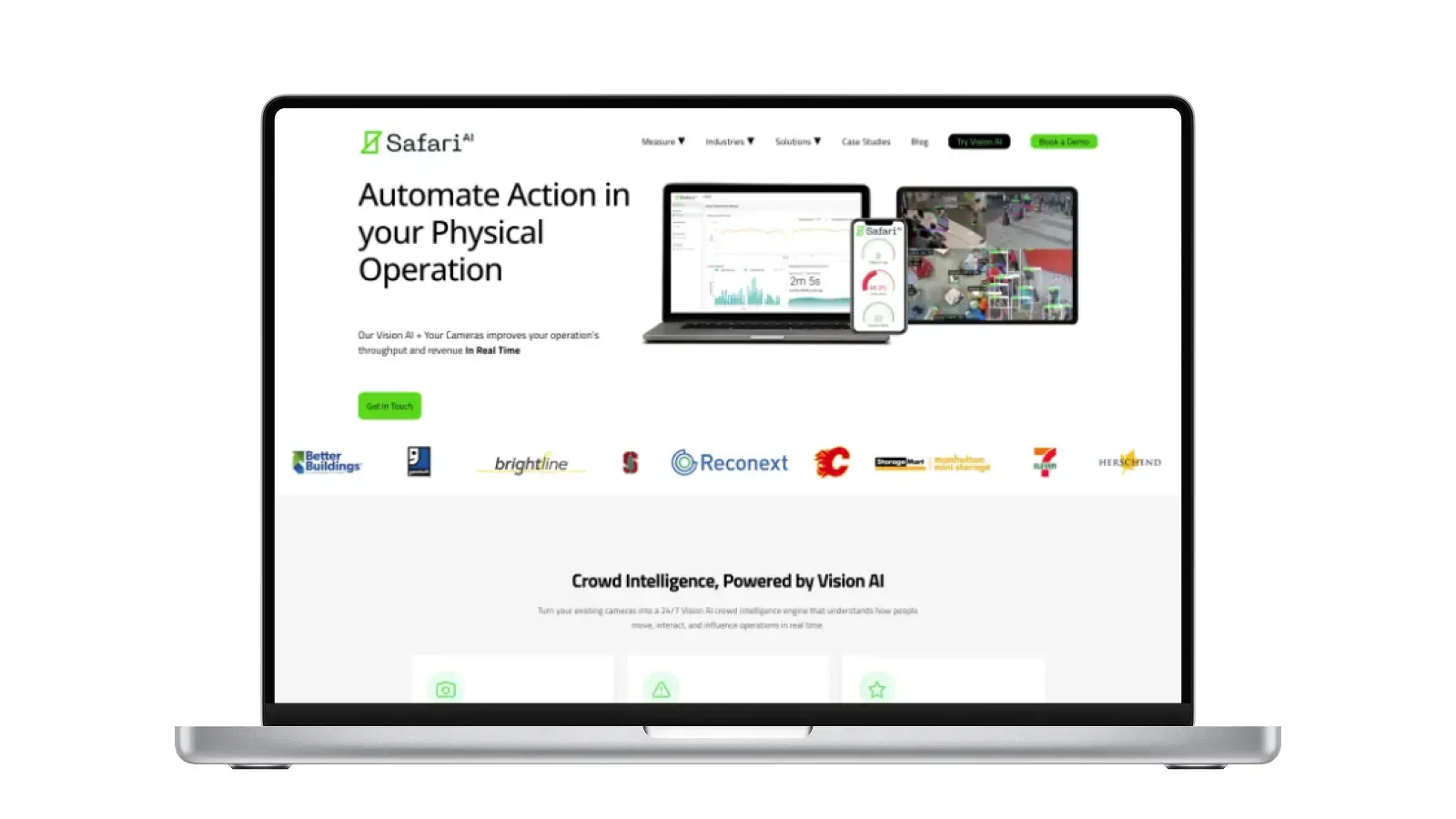
Safari AI is a Miami-based vision AI company that turns existing security cameras into operational intelligence for clients like 7-Eleven, major theme parks, and Stanford. The problem: ten capabilities, six industries, and a website that confused every buyer type. In collaboration with eSEO Space, I designed the full website UI with a three-path navigation structure so enterprise buyers find their specific use case within seconds. The site now ranks for 53 organic keywords, pulls 191 monthly visitors worth $623 in traffic value, and holds #1 for core brand terms.
Safari AI turns existing security cameras into something more useful: real-time data about how people move through a physical space. How many walked in, how long the line is, where the crowd gathers, when staff actually talk to customers. Their technology works with cameras a business already owns. No new hardware.
Their client list tells the story. 7-Eleven uses it across 10+ locations in New York City. Theme parks use it to manage lines. Stadiums track crowd flow. Stanford runs it on campus. Manhattan Mini Storage monitors occupancy.
The technology was already proving itself. But when a new prospect visited the website, they couldn’t figure out what Safari AI actually did for their specific business. Ten different capabilities, six different industries, and one homepage trying to speak to all of them.
That’s a problem I see with a lot of businesses, not just AI companies. If you sell more than one thing to more than one type of customer, your website has to sort people fast. Otherwise everyone bounces.
The problem: too many things, too many buyers
Safari AI does pedestrian counting, occupancy monitoring, vehicle classification, license plate recognition, heatmapping, queue tracking, dwell time analysis, staff engagement scoring, and dispatch optimization. Ten capabilities.
Each one matters to a different buyer. A 7-Eleven operations manager wants door counts and capture rates. The theme park director? Queue wait times. A stadium operator is thinking about crowd density and safety thresholds. They’re all looking at the same product, but none of them care about the same thing.
One product. Ten capabilities. Six industries. And every buyer needs to land on the site and immediately think, “This is for me.”
That’s a harder version of a problem most businesses face. If you’re a contractor who does kitchens, bathrooms, and basements, your website still needs to help the kitchen person find kitchen content fast. Multiply that by ten, and you’ve got Safari AI’s challenge.
The design: helping every buyer find their path
I designed every page of getsafari.ai. The biggest decision had nothing to do with colors or fonts. It was about structure: how do you organize a site so that completely different buyers all find what they need within seconds?
Three doors, one building. A buyer might arrive looking for a specific capability (like pedestrian counting or heatmapping). Or they might arrive from their industry (theme parks, retail, restaurants). Or they might search for a specific problem they’re trying to solve (speed of service, dispatch optimization). The site needed to work from all three starting points.
I designed the homepage to branch into those three paths immediately. An operations director scanning the page picks their door within 5 seconds. No scrolling through content meant for someone else.
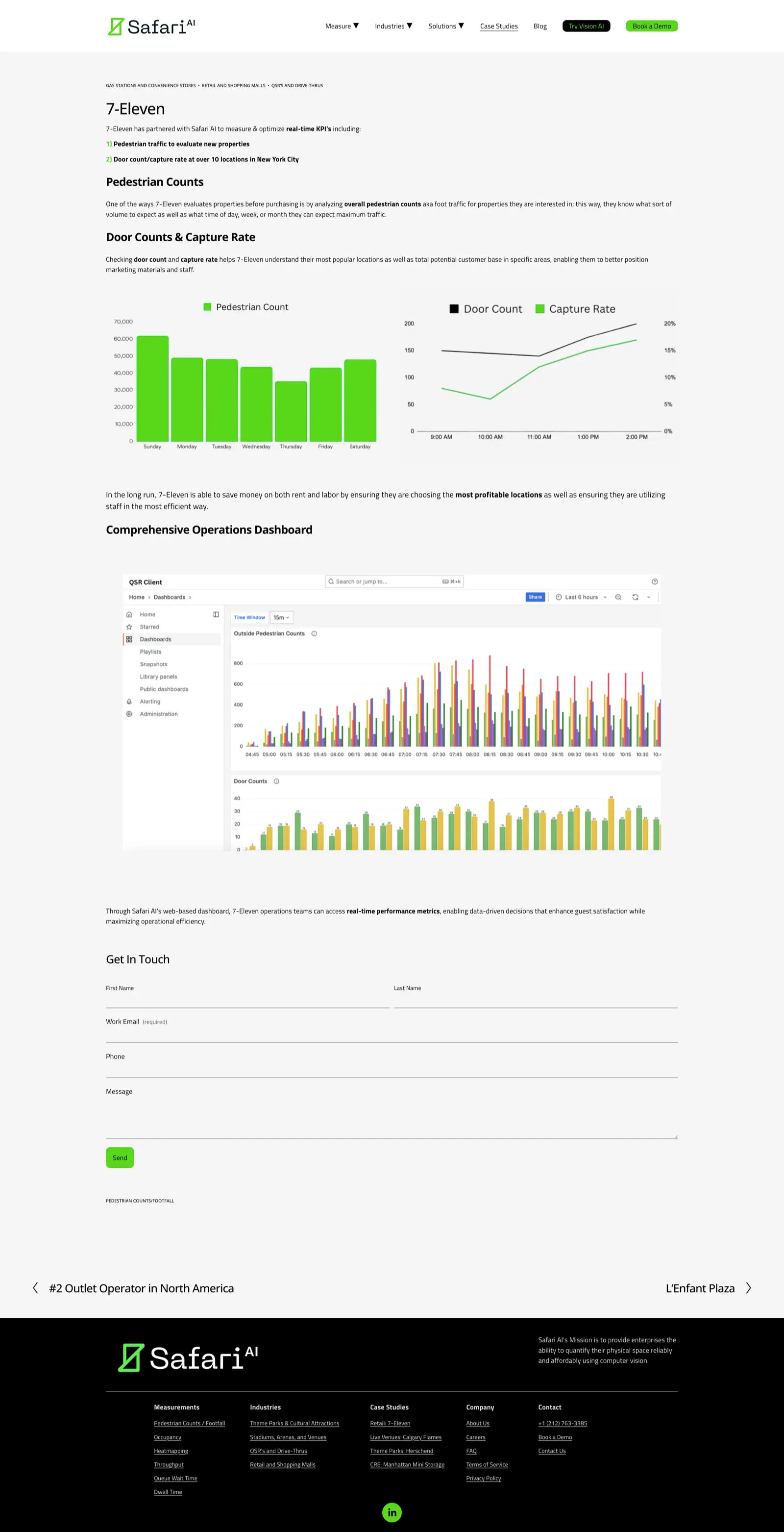
Proof pages, not testimonial pages. Enterprise buyers don’t trust marketing copy. They trust data. The 7-Eleven case study page shows actual pedestrian count charts by day of the week, real capture rate graphs, and a screenshot of the live operations dashboard. Not a stock photo of a happy customer. Actual product data.
That dashboard screenshot answers the one question every serious buyer asks: “What will I actually see if I buy this?” When you show the real interface with real numbers from a company people recognize, the conversation shifts from “convince me” to “show me pricing.”
Works the same way whether you’re selling AI or plumbing services. A before/after photo of an actual kitchen remodel beats “we deliver quality results” every time. Specificity is what builds trust.
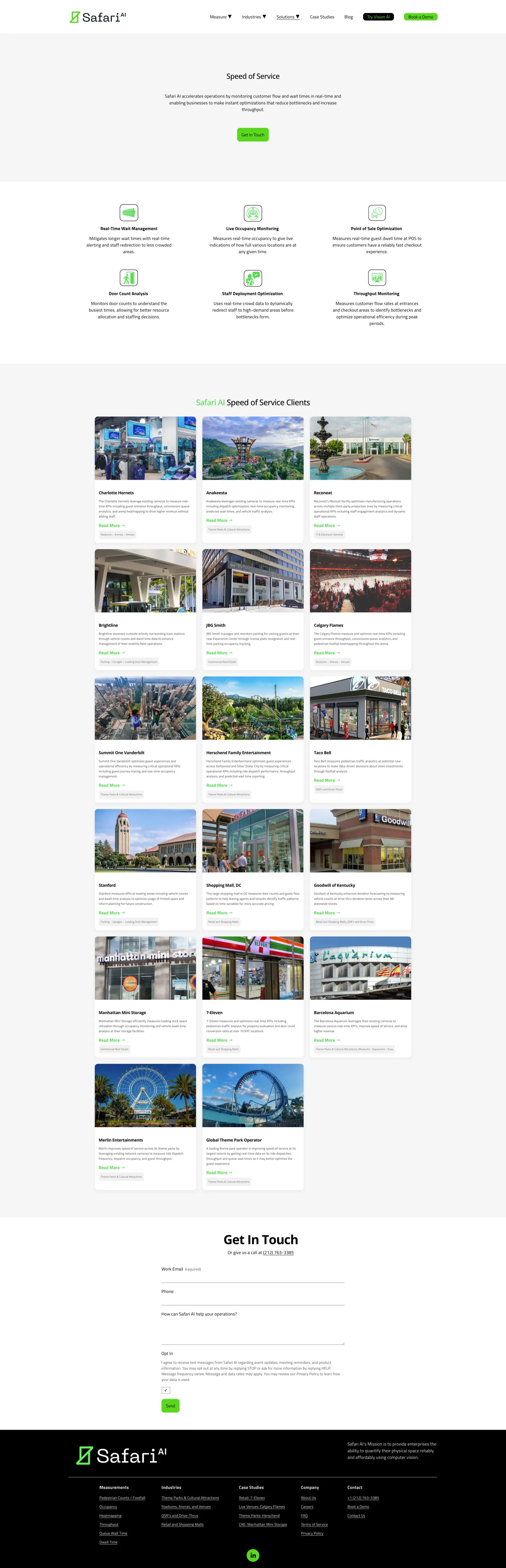
Industry pages that filter out the noise. Each industry page shows only clients from that vertical. When a theme park operator visits, they see other theme parks and attractions. Not convenience stores. Not parking garages. Just their world.
This is what makes someone lean forward instead of bouncing. It’s the same reason a website for a restaurant shouldn’t lead with corporate consulting case studies. People need to see themselves in your work.
Clean and bright, not dark and techy. Vision AI companies tend toward dark, “surveillance” aesthetics. I went the opposite direction. White backgrounds, green accents, clean typography. Safari AI’s pitch isn’t “we watch your cameras.” It’s “we give you data to run your business better.” If the design looks like a security firm, you’ve already framed the conversation wrong.
Here’s what I didn’t expect about this project: the hardest part wasn’t making it look good. It was organizing the content. With ten capabilities and six industries, every layout choice meant someone else’s path got longer. If I led with capabilities, industry buyers had to dig. If I led with industries, someone searching for “heatmapping” wouldn’t see it right away. The three-path structure was the answer, but I had to map every buyer’s journey on paper before I opened a design tool.
I designed Bot Image’s website around the same time. Similar challenge: a complex AI product selling to enterprise buyers. But Bot Image had two products and two audiences. Safari AI had ten and six. The structure had to be much more intentional.

The results: ranking for the terms enterprise buyers actually search
The site launched on WordPress so Safari AI’s team can add new case studies and product pages without calling a developer.
| Metric | Result |
|---|---|
| Organic Keywords | 53 |
| Monthly Organic Traffic | 191 visits |
| Traffic Value | $623/month |
| Peak Keywords | 257 |
| Investment | Under $5K |
| Timeline | Q1 2024 |
The site ranks #1 for their brand terms:
| Keyword | Position | Monthly Searches |
|---|---|---|
| safari ai | #1 | 720 |
| what ai does safari use | #1 | 40 |
| ai safari | #3 | 70 |
More importantly, it ranks for the terms their actual buyers type into Google:
| Keyword | Position | Monthly Searches |
|---|---|---|
| door counts | #3 | 110 |
| doorcounts | #10 | 1,000 |
| dispatch optimization | #18 | 40 |
| footfall traffic analytics | #23 | 40 |
| retail ai vision analytics | #25 | 1,000 |
| lpr licence plate recognition | #37 | 90 |
191 monthly visitors sounds modest until you think about who those visitors are. Safari AI doesn’t need 10,000 random people on their site. They need the operations director at a national chain who’s evaluating technology vendors. One of those visitors is worth more than a year of consumer traffic.
“Doorcounts” gets 1,000 searches a month. “Retail ai vision analytics” gets 1,000. These aren’t casual browsers. These are people actively researching how to improve operations at scale. Safari AI shows up for both.
What made this work
The three-path navigation did the heavy lifting. Instead of forcing everyone through the same homepage, the site lets each buyer type pick their own door. A theme park operator and a 7-Eleven executive never see the same journey. If you sell more than one thing, your site should work the same way.
The case study pages mattered more than I expected. Showing real dashboards and real data from companies people recognize did something the homepage couldn’t. Enterprise buyers (and honestly, most buyers) skip marketing copy and go straight to proof. Making that proof easy to find shortened the path from “who are you?” to “show me pricing.”
Filtering each industry page to only that industry’s clients was the finishing touch. Nobody sees proof that isn’t relevant to them. Your portfolio should work the same way: lead with projects that look like the prospect you’re trying to land.
The partnership
This project was a collaboration with eSEO Space. I designed the complete UI across every page of the site, from research through final visual design. eSEO Space handled WordPress development, SEO optimization, content writing, and client communications.
Is this right for your business?
You don’t need to be an AI company for this to apply. If your business does multiple things for multiple types of customers and your website treats them all the same, you’re losing people.
The fix isn’t complicated. It’s about organizing what you already have so the right visitor finds the right content fast. Safari AI went from a confusing site to a clear one for under $5,000. The technology didn’t change. The website did.
If your site makes people work too hard to find what they need, let’s talk about it. I’ll look at your current site and show you where visitors are getting stuck.
FAQs
My business offers multiple services. Does my website need separate pages for each one?
Almost always, yes. If you’re a contractor who does kitchens, bathrooms, and basements, having one generic “Services” page forces every visitor to dig for what they care about. A homeowner who wants a kitchen remodel should land on a page about kitchen remodels, see photos of kitchens you’ve done, and read about your kitchen process. Not scroll past bathroom content to get there. Safari AI had this same problem at ten times the scale. The solution is the same: give each service its own page with its own proof.
How do you make a complex product or service easy to understand on a website?
Start with what the customer cares about, not what you’re proud of. Safari AI could lead with their AI technology and computer vision algorithms. Instead, the site leads with what each buyer type needs: “door counts” for the retail operator, “queue wait times” for the theme park director. Talk about the outcome first. Explain the technology second, and only when the buyer needs it to feel confident.
How much does a multi-page business website cost?
This project was completed for under $5,000 for design across all pages. Development, SEO, and content were handled separately by the development partner. A comparable site with multiple audience paths and distinct product pages typically runs $3,000 to $10,000 for design, depending on how many pages and how complex the structure. A simpler business site with 5 to 10 pages usually falls under $5,000 for the whole thing.
Can a new or small company compete online against bigger competitors?
Size matters less than specificity. Safari AI competes in the same space as massive companies, but they win on focus. Their site doesn’t try to be everything to everyone. It targets the specific buyer types who need exactly what they offer and shows proof that it works. A local plumber doesn’t need to outrank Angi for “plumber.” They need to own “emergency plumber in [their city].” The same principle applies at every scale: specific beats general.
Project Gallery
Case study by
Kristian Kreaktive
Founder & Lead Strategist at Digital Marketing Services
17+ years of experience helping small businesses grow their online presence through strategic SEO, web design, and branding. Featured in Google's marketing resources.
In collaboration with
eSEO Space
UI Design (All Pages)
I designed the complete website UI across all pages. eSEO Space handled WordPress development, SEO optimization, content writing, and client communications.
Learn more about our partnershipMore Digital Marketing Clients from Miami

Website Redesign for a Regenerative Medicine Clinic That Actually Converts
Younger Me MDHow we built a website for a regenerative medicine clinic that converts. See the strategy behind the design that finally reflects their expertise.
563 organic keywords, #1 for 9,900-volume terms, and AI citing 27 pages across ChatGPT, Google AI, and Gemini
More Web Design Success Stories
Website Redesign for a 30-Year AV Production Company in Orlando
455 organic keywords ranking with #1 positions and AI search visibility across 4 platforms
Website Redesign for an HVAC-R Nanotechnology Company in Houston
Full website redesign with industry-specific landing pages for a global HVAC-R nanotechnology company

Bot Image AI: Zero to 158 Keywords for FDA-Cleared Tech
158 organic keywords with #1 positions for ProstatID and core brand terms