




On this page
TL;DR
PurePEG is a San Diego biotech manufacturer of monodisperse polyethylene glycols, specialized chemical building blocks used in cancer drugs and vaccine development. Their 1,000+ product catalog was nearly impossible to navigate, and the old site looked like 2015 while competitors like Sigma-Aldrich (Merck) had sophisticated search tools. I redesigned the information architecture, product discovery experience, and 15 application-specific landing pages (with eSEO Space building the WordPress/WooCommerce site). PurePEG now ranks #1 on Google for “cleavable linker” with an AI Overview feature, holds 116 organic keywords including top-5 positions for terms like “maleimide” (1,300 monthly searches), and outranks billion-dollar competitors in their niche.
Update, February 14, 2026: PurePEG now ranks #1 on Google for “cleavable linker” and is featured in Google’s AI Overview for that term. When a researcher asks Google (or an AI chatbot) about cleavable PEG linkers, PurePEG is the answer. For a company with 1,000 specialized products in a market most people have never heard of, that’s exactly the position you want. More on this below.
The Numbers That Matter
| What We Built | The Result |
|---|---|
| Organic Keywords Ranking | 116 (in top 100) |
| #1 Position | ”Cleavable linker” (with AI Overview) |
| Top-5 Positions | 8 keywords including “maleimide” (1,300 monthly searches) |
| AI Overview Featured | Yes, for key product terms |
| Core Web Vitals | All green (LCP 1.068s, CLS 0.04, TTFB 0.282s) |
| Products Cataloged | 1,000+ across 15 categories |
| Competitors Outranked | Sigma-Aldrich (Merck), BioSynth, VectorLabs |
The Problem: 1,000 Products Nobody Could Find
PurePEG manufactures something most people will never hear about: monodisperse polyethylene glycols. If that sounds like gibberish, here’s the simple version. They make specialized chemical building blocks used in cancer drugs, vaccine development, and pharmaceutical research.
Their products are used in drugs that have been approved by regulators in the US and Europe. This is serious science, not a commodity.
The problem wasn’t the product. PurePEG’s proprietary PurePEG™ technology produces PEGs with a single, defined molecular weight. Most competitors sell mixtures. Think of it like selling a precisely cut diamond versus a bag of random gemstones. The precision matters enormously in drug development.
The problem was the website.
Over 1,000 products spread across 15 categories, and the existing site made finding the right one feel like searching through a filing cabinet with no labels. Scientists were wasting minutes (sometimes more) hunting for specific compounds. In a world where researchers are racing deadlines for drug trials, that friction costs more than lost sales. It costs trust.
The site’s design didn’t match the product quality. Here’s a company making some of the purest PEG compounds on the market, and their website looked like it was built in 2015. Slow loading. No advanced filtering. No product comparison. No way to search by functional group, molecular weight, or CAS number.
Meanwhile, their main competitors (Sigma-Aldrich, a subsidiary of Merck, BioSynth, VectorLabs) had sophisticated product search and filtering tools. PurePEG was competing on product quality while losing on digital experience.
This Works Well For
This case study is most relevant if you:
- Manufacture or distribute specialized scientific, medical, or technical products
- Have a catalog of 100+ products that buyers need to search and compare
- Compete against larger companies with better-funded websites
- Sell to a niche audience where each customer is worth thousands
- Need your website to work as a product discovery tool, not just a brochure
Industry fit:
- Biotech and pharmaceutical suppliers
- Scientific equipment and reagent manufacturers
- B2B e-commerce with complex product specifications
- Medical device companies with technical catalogs
- Specialty chemical and materials suppliers
This probably isn’t your situation if:
- You sell a handful of simple products
- Your customers don’t need to compare technical specifications
- You’re in a consumer market where brand awareness matters more than findability
- Your products don’t have search demand (people aren’t Googling for them)
The Strategic Insight: Small Markets, Big Wins
Here’s something most business owners don’t understand about niche markets.
The total search volume for PEG chemistry terms is small. “Maleimide” gets 1,300 searches per month. “PEG linker” gets 170. “Cleavable linker” is even smaller. Most SEO agencies would look at those numbers and say “not worth targeting.”
They’d be wrong.
Because the person searching “cleavable linker” isn’t a casual browser. That’s a pharmaceutical researcher with a budget, a deadline, and a very specific need. A single order from that search could be worth $5,000, $10,000, or more. Some custom synthesis orders run into six figures.
In niche B2B markets, traffic volume is irrelevant. What matters is owning the entire purchase journey for your specific market.
I’ve seen this pattern repeatedly with specialized clients. When you become the dominant online presence in a narrow market, something powerful happens: you stop competing and start being the default answer. Researchers bookmark you. Procurement teams add you to their approved vendor lists. AI tools start citing you as the authoritative source.
That’s not a ranking. That’s a moat.
PurePEG didn’t need 7,500 monthly visitors. They needed the RIGHT visitors. Scientists, researchers, and procurement managers who are actively looking for exactly what PurePEG sells.
And now, when those people search, PurePEG shows up first.
What We Actually Did
This project was a collaboration. I handled the website design, user experience strategy, information architecture, and SEO-focused content structure. My development partner, eSEO Space, built the WordPress/WooCommerce infrastructure, handled performance optimization, and executed the technical implementation.
We’ve worked together for over 4 years. They’re the technical team I trust for complex e-commerce builds.
Redesigned the Product Discovery Experience
The core challenge: how do you make 1,000+ chemical products findable by scientists who think in molecular structures, not marketing categories?
I built the information architecture around how researchers actually search:
- By functional group (what the molecule does)
- By PEG units (molecular weight/size)
- By application (drug delivery, bioconjugation, diagnostics)
- By product number or CAS number (when they know exactly what they want)
The filtering system lets researchers narrow 1,000+ products to the exact compound they need in seconds. Not minutes. Seconds.
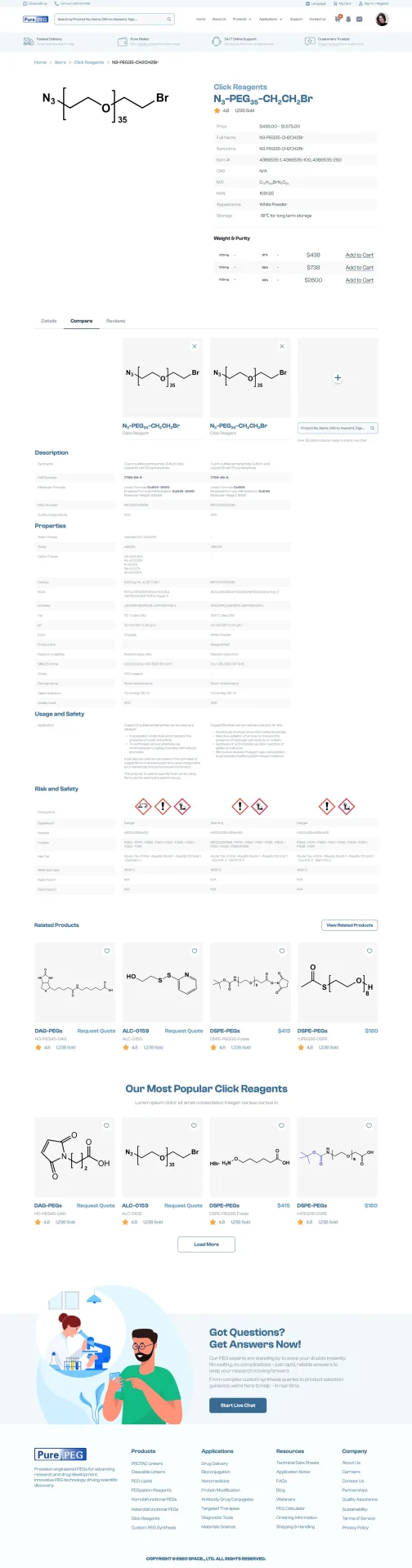 Product Comparison
Product comparison: Researchers can compare specifications, molecular weights, and pricing side-by-side. A feature their previous site didn’t have.
Built 15 Application-Specific Landing Pages
Most scientific suppliers organize by product category. That’s fine for catalog navigation, but it misses how Google (and researchers) search.
I created dedicated landing pages for each major application area: Antibody-Drug Conjugates (ADCs), Nanomedicine, Drug Delivery, Bioconjugation, Protein Modification, Photodynamic Therapy, Diagnostics, Materials Science, and Targeted Therapies.
Each page answers the questions researchers actually ask about PEG applications in that field. Not product listings. Educational, authoritative content that positions PurePEG as the expert.
This is what Google (and AI search tools) reward: deep, specific content written by people who understand the subject.
Designed for the Science, Not the Marketing
The visual design had to walk a specific line. Scientific professionals distrust anything that looks like consumer marketing. Too flashy, and they question your credibility. Too plain, and you look outdated.
I designed PurePEG’s site to feel like a research tool, not a marketing site. Clean layouts. Clear data presentation. Dark blue and white color scheme that projects authority without stuffiness. The molecular structure imagery reinforces the scientific identity without overwhelming the product content.
The design says “we take this as seriously as you do.”
SEO Built Into the Foundation
Every design and content decision was made with search visibility in mind. Not as an afterthought, but as a core requirement.
Schema markup for products, so Google understands PurePEG sells specific chemical compounds with defined properties, not just generic “PEG products.”
Content depth on each product category page, including detailed descriptions, application context, and comparison information. This is the kind of content Google’s algorithms (and AI models) need to confidently recommend a source.
Technical foundation with clean URL structure, proper canonicalization, and optimized metadata for every product and category page.
Performance That Passes Every Test
eSEO Space built the WordPress/WooCommerce site for speed. With 1,000+ products and complex filtering, performance could easily become a problem. It didn’t.
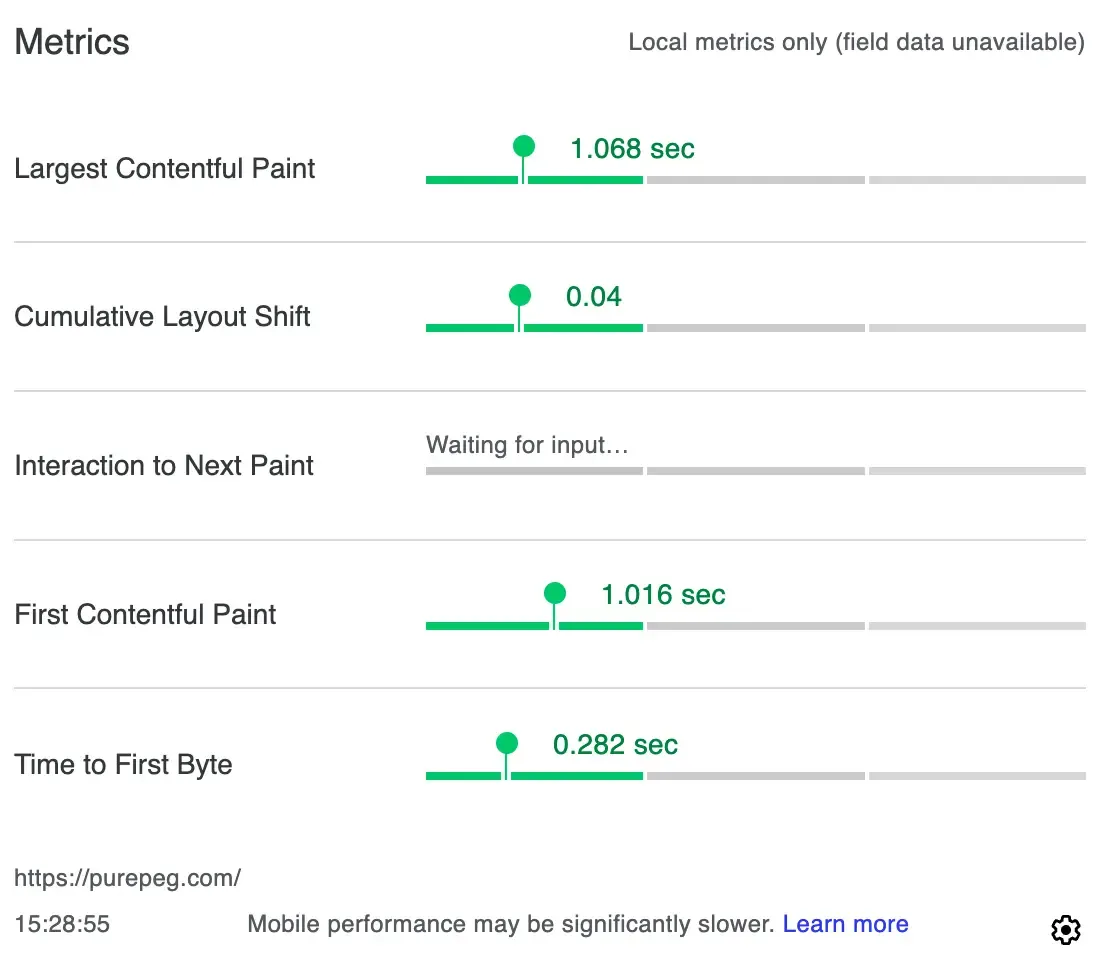 Core Web Vitals: All green. Fast pages mean better rankings and a better experience for researchers who don’t have time to wait.
The numbers:
- Largest Contentful Paint: 1.068 seconds
- Cumulative Layout Shift: 0.04
- First Contentful Paint: 1.016 seconds
- Time to First Byte: 0.282 seconds
For a site with 1,000+ products, complex filtering, and a full e-commerce checkout, these are excellent numbers. Every metric passes Google’s Core Web Vitals thresholds with room to spare.
The Results: Dominating a Niche Market
Organic Search Rankings
Within months of launch, PurePEG’s organic visibility transformed:
- 116 keywords ranking in Google’s top 100
- 8 keywords in the top 5, including “maleimide” (1,300 monthly searches)
- “Cleavable linker” jumped from invisible to #1 on Google
- Outranking Sigma-Aldrich (Merck), BioSynth, and VectorLabs on multiple terms
To put “maleimide” in context: that’s a compound used in drug development, bioconjugation, and protein modification. The companies searching for it are pharmaceutical manufacturers and research institutions. Position #5 for that term, above competitors backed by billion-dollar parent companies, from a website redesign and thoughtful SEO structure.
The AI Search Win
This is the result I’m most excited about.
PurePEG doesn’t just rank #1 for “cleavable linker” in traditional Google results. The site is featured in Google’s AI Overview for that term.
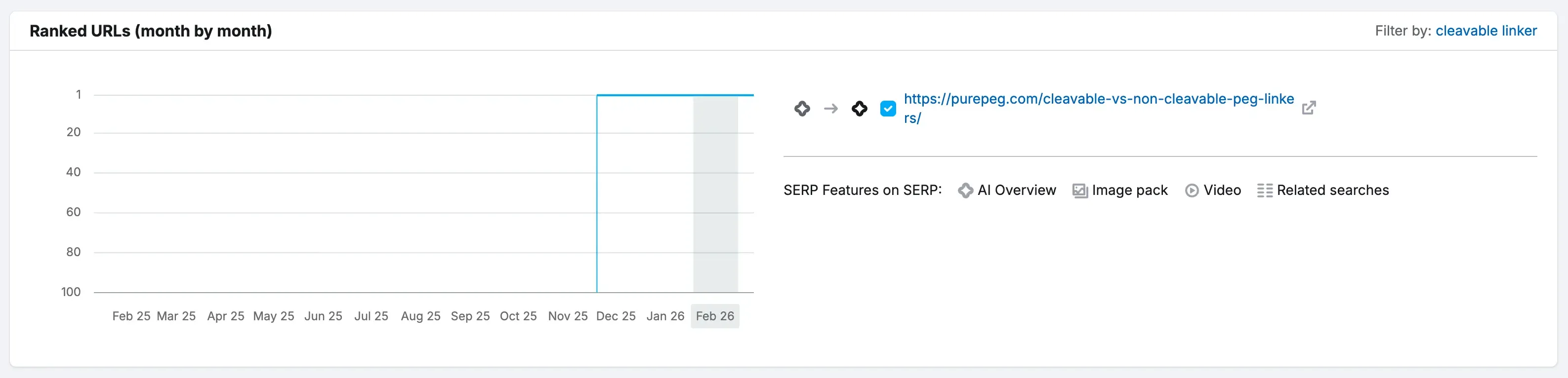 Semrush data: PurePEG’s cleavable linker page jumped from invisible to #1, with AI Overview SERP feature confirmed.
When a researcher asks Google’s AI (or any AI-powered search tool) about cleavable PEG linkers, PurePEG is the source it cites.
This matters because search is changing. Researchers increasingly use AI tools to find suppliers and understand products. A company that shows up in both traditional search results AND AI-generated answers has locked down visibility for the foreseeable future.
In 2026, being the source that AI recommends is becoming as important as ranking #1 in traditional search. PurePEG has both.
What These Rankings Mean in Business Terms
Here’s the part most agencies gloss over: what do these rankings actually mean for revenue?
In niche B2B, the math works differently than consumer e-commerce:
| Metric | Consumer E-Commerce | Scientific B2B (PurePEG) |
|---|---|---|
| Monthly visitors needed | 10,000+ | 50-100 qualified |
| Average order value | $50-150 | $500-50,000+ |
| Customer lifetime value | 1-3 orders | Years of repeat purchases |
| Cost of switching | Low (click away) | High (qualification, testing) |
One researcher who finds PurePEG through a “cleavable linker” search and places a custom synthesis order could be worth more than 1,000 consumer purchases. And once a pharmaceutical company qualifies a supplier, they rarely switch. The cost of re-validating compounds for regulatory compliance is too high.
These aren’t one-time sales. They’re long-term customer relationships that started with a Google search.
The Bigger Lesson: Own Your Niche
PurePEG is a pattern I’ve seen work repeatedly with specialized businesses.
The mistake most niche companies make is thinking their market is “too small” for SEO. They look at the search volumes, see low numbers, and ignore search entirely. They rely on trade shows, word of mouth, or paid advertising.
But here’s what happens when you DO invest in owning your niche online:
- You become the default. When every relevant search leads to your site, you stop competing and start being the assumed choice.
- AI amplifies your position. AI search tools need authoritative sources. When you’re the most comprehensive, well-structured resource in a niche, AI cites you. That creates a compounding advantage your competitors can’t easily replicate.
- The moat deepens over time. Every month of content, every product page indexed, every AI citation builds authority that makes it harder for competitors to catch up. The first mover in niche SEO often stays dominant for years.
PurePEG’s market might seem small from the outside. Monodisperse PEGs for pharmaceutical research isn’t exactly a trending topic. But the companies in that market have serious budgets and long purchasing cycles. Owning position #1 for the terms those buyers search is worth far more than ranking for a consumer keyword with 100x the volume.
If you’re a specialized business thinking “our market is too niche for this,” PurePEG’s results should change that perspective. The smaller the market, the faster and more completely you can dominate it.
The Tech Stack
For those curious about the technical implementation:
- CMS: WordPress
- E-Commerce: WooCommerce (customized for scientific B2B sales)
- Advanced Search: Custom-built filtering by functional group, molecular weight, CAS number, and application area
- Product Comparison: Side-by-side specification comparison (molecular weight, purity, pricing)
- Chemical Structure Drawing: EPAM Draw Tool for SMILES string submission (custom synthesis orders)
- Quick Order: Past orders and bulk ordering for returning customers
- Performance: Optimized for 1,000+ product pages with complex filtering
- Security: SSL-encrypted payment processing
About the Partnership
This project was a collaboration between two specialized teams:
Digital Marketing Services (DMS):
- Website design and user experience strategy
- Information architecture for 1,000+ product catalog
- SEO strategy and content structure
- Application-specific landing page content
- Visual design matching scientific brand standards
eSEO Space:
- WordPress/WooCommerce development
- Advanced product filtering and comparison tools
- Performance optimization
- E-commerce checkout and payment integration
- Chemical drawing tool integration
I’ve worked with eSEO Space for over 4 years. When e-commerce projects require complex technical execution, they’re the team I bring in. This model works because each team focuses on their specialization.
The result is a site that scientists trust, Google rewards, and AI cites as authoritative.
Common Questions
Frequently Asked Questions
Yes, and it often works better than in high-volume markets. Low search volume means low competition. PurePEG went from invisible to #1 for key terms because the competition for specific PEG chemistry searches is limited. The trade-off is that each visitor is worth significantly more. One pharmaceutical researcher placing a custom synthesis order can be worth more than thousands of consumer clicks.
SEO isn't just keywords and backlinks. Site structure, content organization, page speed, and user experience all affect how Google ranks pages. PurePEG's old site had no clear structure for Google to understand what they sold. The redesign organized 1,000+ products into logical categories with dedicated landing pages for each application area. Google could finally understand and rank the content.
Google's AI Overview (sometimes called AI Summaries) is a generated answer that appears at the top of search results. When someone searches 'cleavable linker,' Google's AI reads multiple sources and generates a summary. PurePEG's content is cited in that summary. This means PurePEG gets visibility even before a user scrolls to the traditional search results.
Sigma-Aldrich sells millions of products across every chemical category imaginable. That's their strength for broad searches, but a weakness for specific niches. PurePEG's entire site is focused on PEG chemistry. Every page, every product description, every application guide reinforces that focus. Google rewards depth and specificity. A dedicated PEG specialist will outrank a generalist for PEG-specific searches, regardless of company size.
Researchers are often searching during active experiments or project deadlines. A slow site gets abandoned. Beyond user experience, Google uses page speed as a ranking factor. PurePEG's site loads in about 1 second (LCP 1.068s) with a 0.282-second server response time. For a site with 1,000+ products and complex filtering, those numbers are well above average.
Scientific buyers search differently. They use chemical names, CAS numbers, molecular formulas, and application-specific terms. The product filtering needs to work by functional group and molecular weight, not just price and color. And the trust bar is higher. A pharmaceutical company won't buy from a site that looks unprofessional because product quality and supplier reliability are non-negotiable in their industry.
The information architecture was built around how researchers actually think. Products can be found by category (PROTAC Linkers, Cleavable Linkers, PEG-Lipids, etc.), by functional group, by molecular weight range, by application area, or by searching a specific product number or CAS number. The goal was making any product findable in under 10 seconds, regardless of how the researcher thinks about what they need.
For this market, yes. PurePEG's product space has a finite number of relevant search terms. Ranking for 116 of them means they're visible for the vast majority of searches their target customers make. In niche B2B, covering 80%+ of your market's search landscape matters more than raw keyword counts. A consumer site might need 10,000 keywords. PurePEG needs 116 of the right ones.
The site was built with growth in mind. PurePEG plans to double their catalog to 2,000+ products. The information architecture, filtering system, and category structure all support expansion without redesign. Each new product page is another ranking opportunity. As the catalog grows, so does the organic visibility.
If you sell specialized products to a professional audience that searches for them online, yes. The principles are the same whether you sell chemical compounds, industrial equipment, medical devices, or any other niche B2B product. The key question is: are your customers searching for what you sell? If yes, the combination of strong UX, proper site structure, and authoritative content will produce results.
Not Ready Yet?
That’s okay. Here’s how to prepare for when you are.
Do this now (free):
- Search your top 5 product names on Google. Note where you rank (or if you rank at all).
- Ask ChatGPT or Google’s AI about your product category. See if your company comes up.
- Time how long it takes a new visitor to find a specific product on your current site.
Questions to answer before we talk:
- How many products are in your catalog?
- How do your customers currently find and order from you?
- Are your competitors ranking ahead of you in search?
- Does your website reflect the quality of your products?
When the timing is right: I’m happy to take an honest look at whether a redesign and SEO strategy makes sense for your specific situation. No obligation, no pressure.
If your products are specialized, your customers search for them online, and your current website doesn’t reflect the quality of what you sell, let’s talk about what’s possible.

Case study by
Kristian Kreaktive
Founder & Lead Strategist at Digital Marketing Services
Ranked #1 freelance web designer by Clutch. 17+ years building websites and SEO strategies that bring real results for small businesses.
In collaboration with
eSEO Space
Design & Development
This project was created in collaboration with eSEO Space, combining our strategic approach with their technical expertise to deliver exceptional results.
Learn more about our partnershipMore Digital Marketing Clients from San Diego
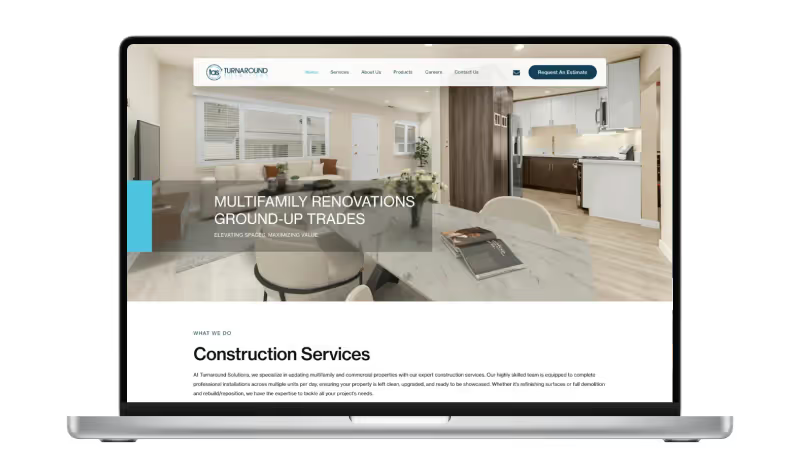
Website Design for Multifamily Renovation Contractor in Gardena
Professional B2B digital presence for a contractor with $1B+ in property acquisitions

Website Redesign That Turns a Product Catalog Into a Lead Engine
240+ organic keywords with multiple #1 rankings, rebuilt from a 91-visit algorithm crash
More Web Design Success Stories

Website Redesign for a 30-Year AV Production Company in Orlando
455 organic keywords ranking with #1 positions and AI search visibility across 4 platforms
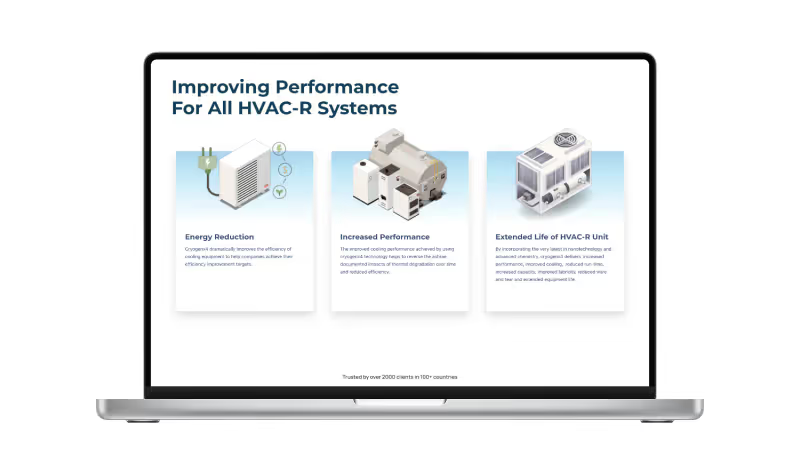
Website Redesign for an HVAC-R Nanotechnology Company in Houston
Full website redesign with industry-specific landing pages for a global HVAC-R nanotechnology company
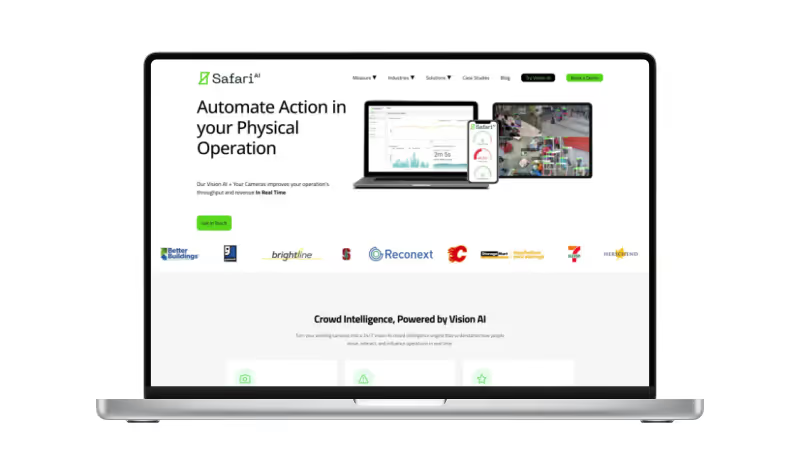
Safari AI: Designing clarity for a vision AI platform serving 7-Eleven and theme parks
53 organic keywords with #1 positions for core brand terms and enterprise case study pages