


On this page
The Numbers That Matter
| What We Built | The Result |
|---|---|
| AI Visibility Score | 16 (ChatGPT, Gemini, AI Overview, AI Mode) |
| AI Mentions | 16 across AI platforms |
| Cited Pages | 32 pages referenced by AI |
| Keywords Ranking | 241 |
| #1 Positions | 10+ (including “olive oil from greece,” “where to buy greek olive oil”) |
| Backlinks | 445 from 164 referring domains |
| From Scratch | Brand new site, zero previous online presence |
| Investment Range | $5K-10K for complete e-commerce design |
| Timeline | Design completed in ~6 weeks, full launch in 3-4 months |
The Problem: A Great Product With No Online Presence
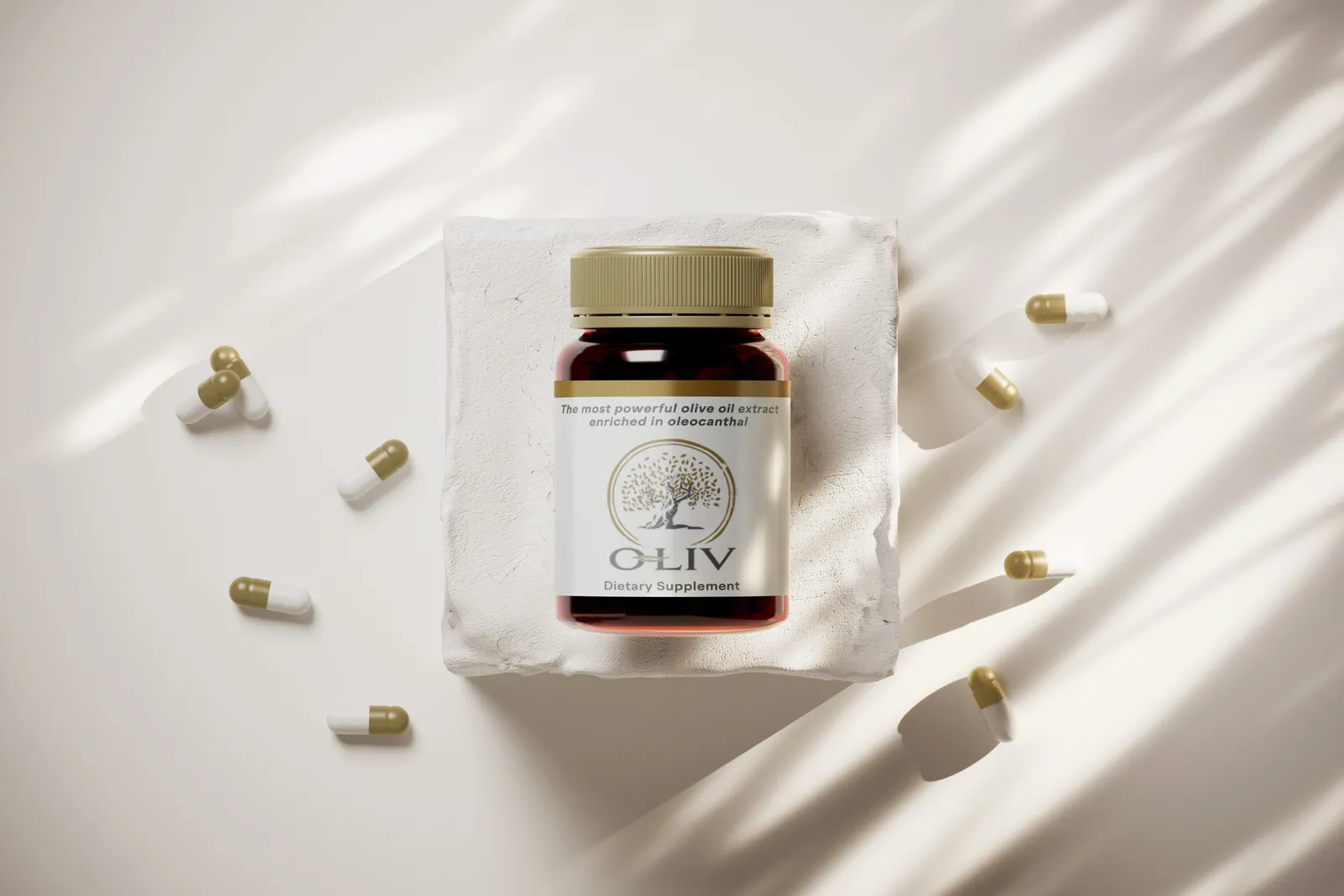
O-Liv had a product that genuinely works. High phenolic olive oil in capsule form, tested, certified, sourced from organic olives grown in Greece. The kind of product that sells itself once people understand what it does.
The problem? Nobody could find it.
O-Liv was selling locally in Bettendorf, Iowa through word of mouth and small retail relationships. No website. No e-commerce store. No way for someone in another state to discover or buy the product. They were sitting on a legitimate health product backed by clinical research, polyphenol analysis certificates, and real customer results, but without a digital storefront, none of that mattered.
Health supplement e-commerce is a crowded space. Amazon dominates the broad terms. Established brands own the first page of Google. And the supplement industry has a trust problem: too many products with big claims and no proof.
O-Liv needed more than a Shopify store. They needed a web design experience that built trust from the first scroll.
This Works Well For
This case study is most relevant if you’re in one of these situations:
- You have a product people love in person, but nobody can find it online
- You’re launching an e-commerce store from scratch and need it to look credible from day one
- Customers need to trust your product before buying (health, wellness, supplements, food)
- You want your brand showing up when people ask ChatGPT or Google AI for recommendations
- You’ve been relying on word of mouth and local sales, and you’re ready to sell nationally
The business stage that fits:
- Small business owners with a proven product but no online storefront
- Founders moving from local retail or farmers market sales to direct-to-consumer e-commerce
- Health and wellness brands that need their website to do the convincing (not just the selling)
- Food, supplement, or beauty brands where trust is the #1 purchase barrier
This probably isn’t your situation if:
- You already have strong brand recognition and just need a visual refresh
- Your product is a commodity where price is the only factor
- You want a template Shopify store with no custom design work
The Design Challenge: Trust at Every Touchpoint
Selling health supplements online comes with a unique design challenge. Your customer is about to put something in their body based on what they read on a screen. If the design feels cheap, generic, or untrustworthy, they leave. No second chances.
I designed O-Liv’s entire e-commerce experience in Figma. Every page, every interaction, every visual decision was intentional.
The core principle: trust signals embedded in the design, not bolted on as afterthoughts.
The Homepage Experience
The homepage needed to accomplish three things in the first 5 seconds: explain the product, establish credibility, and make the purchase path obvious.
I opened with a clean hero section. The headline (“Make high-phenolic olive oil part of your daily routine”) speaks to the daily habit, not the product specs. Below that, four trust badges above the fold: Tested & Certified, Product of Greece, No Calories, Vegetarian Capsule.
The product section immediately follows with pricing, proven benefits, and a clear CTA. No scrolling through mission statements before you understand what you’re buying.
Product Pages Built for Conversion
Supplement product pages need to do something most e-commerce pages don’t: educate and convince simultaneously.
I structured the product pages with a dual approach. The top section handles the purchase decision: product image, pricing (with the crossed-out original price for urgency), and key benefits. The “Why Choose O-Liv?” section below handles objections: polyphenol retention, shelf life, science-backed benefits, and convenience.
The “Packed with Health Benefits” section uses a customer testimonial as social proof, followed by a visual grid of specific health benefits (inflammation, cholesterol, blood sugar, neurodegeneration). Each benefit has its own card, making complex health information scannable.
The Our Story Page: Credibility Through Transparency
For supplement brands, the “About” page isn’t a nice-to-have. It’s where skeptical buyers go to decide if they trust you.
I designed the Our Story page to lead with mission, show the real team (Peter Maios, DO, MPH and Jo Di Orio, RN), and walk through the origin story with a visual timeline. The Mediterranean Diet Conference discovery, the partnership with Greek manufacturers, and the journey from sampling to launch.
The page closes with “Olive Oil Is Medicine,” a testimonial from a real user with specific results. Not vague claims. Specific numbers.
Beyond the Core: Quiz and Contact
The olive oil knowledge quiz was designed as an engagement tool. Instead of pushing the product, it asks questions about lifestyle and health goals, then recommends whether O-Liv fits. It’s a soft sell that builds the relationship before the transaction.
The contact page uses a split layout: a warm, authentic photo of olive harvesting alongside a straightforward form. Professional but approachable.
 Homepage
 Product Detail
 Supplement Product
The Results: From Zero to AI-Cited in 8 Months
This is where the story gets interesting.
The design was my contribution. But the results came from the full package: design + development + SEO + content + marketing, executed by both teams.
Traditional SEO Performance
Within 8 months of launch, O-Liv’s site earned:
- 241 organic keywords ranking in Google
- 10+ #1 positions including “olive oil from greece” (480 monthly searches), “where to buy greek olive oil” (390), and “best high phenolic olive oil”
- 445 backlinks from 164 referring domains
- Rankings across informational (53.4%), commercial (40.1%), and transactional (4.5%) intent keywords
The blog content that eSEO Space created is driving the bulk of organic visibility. Articles like “Greek vs. Italian Olive Oil” and “Top High Phenolic Olive Oil Brands Reviewed” are ranking #1 for multiple high-value terms.
The AI Visibility Story
Here’s what most people aren’t paying attention to yet.
O-Liv doesn’t just rank in traditional Google search. The site is being cited across AI-powered search platforms:
AI Search Visibility (February 2026)
- AI Visibility Score: 16 across all platforms
- ChatGPT: 27 cited pages
- Google AI Overview: 7 mentions, 5 cited pages
- Google AI Mode: 7 mentions, 11 cited pages
- Gemini: 2 mentions, 3 cited pages
- Total: 16 mentions, 32 cited pages across AI platforms
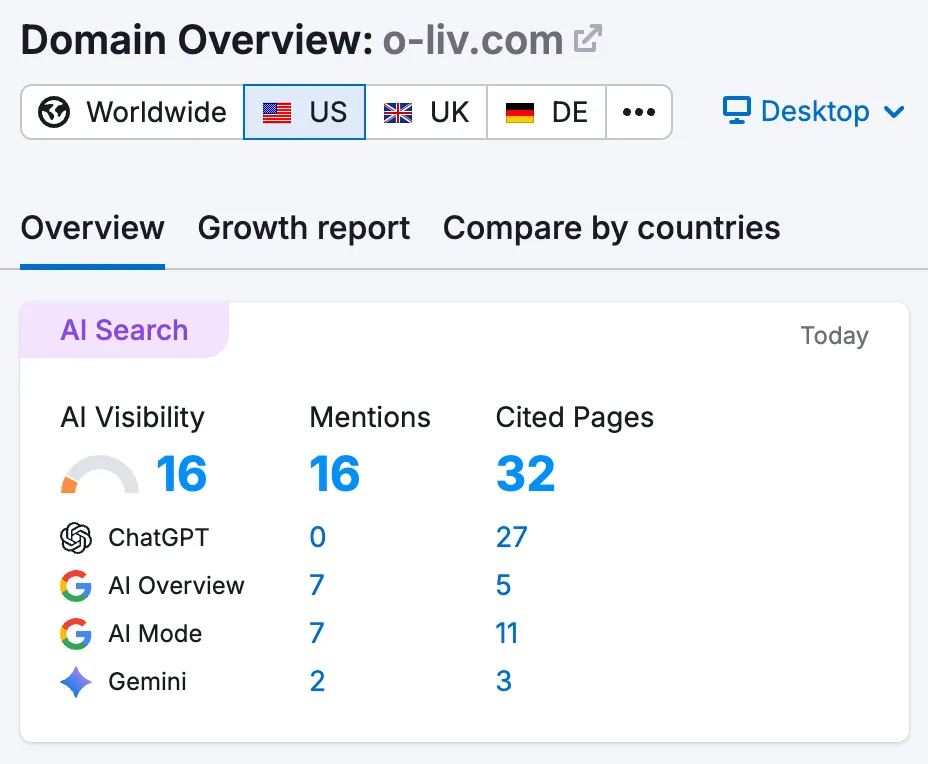 Real data from Semrush, February 2026: O-Liv is being cited across every major AI search platform.
This matters because AI search is where consumer behavior is heading. When someone asks ChatGPT “what’s the best high phenolic olive oil?” or asks Gemini about olive oil supplements, O-Liv’s content shows up. Not as an ad. As a cited source.
Most brands are still optimizing exclusively for traditional Google rankings. O-Liv is already visible in the next generation of search. That’s a head start most competitors don’t even know they’re missing. (If you’re curious about how this works, I wrote about AI optimization as a service.)
What Made This Work
Three things came together on this project:
1. Design that builds trust instantly. The visual experience I created in Figma was purpose-built for a trust-sensitive category. Every design decision, from the polyphenol analysis certificate references to the real team photos on the Our Story page, was about answering the question: “Can I trust this product?”
2. Content that AI platforms want to cite. eSEO Space created research-backed blog content that AI systems recognize as authoritative. Articles comparing olive oil origins, reviewing phenolic content, and explaining dosage recommendations. This is exactly the type of content that ChatGPT and Gemini pull into their responses.
3. Technical execution on Shopify. Clean code, fast load times, proper SEO markup, and a mobile-first build. The technical foundation eSEO Space built makes it easy for both traditional search engines and AI crawlers to understand and trust the content.
About the Partnership
This project was a collaboration between two specialized teams:
Digital Marketing Services (DMS):
- Complete website UI/UX design in Figma
- Page layouts for Home, Shop, Product Detail, About Us, Contact, and Quiz
- Visual hierarchy and conversion optimization
- Trust signal integration into the design system
eSEO Space:
- Shopify development and theme customization
- SEO strategy and keyword research
- Blog content creation and content marketing
- Email marketing setup
- Technical SEO and performance optimization
- Quiz functionality and marketing integrations
I’ve worked with eSEO Space for over 4 years. When e-commerce projects need the full development and marketing stack, they handle the execution while I focus on design strategy. This model works because each team stays in their zone of expertise.
Common Questions
Frequently Asked Questions
This project fell in the $5,000-10,000 range for the complete design. That covered all core pages: homepage, shop, product detail, about, contact, and an interactive quiz. The investment varies depending on how many products you sell and how much custom design work is needed. For a single-product or small-catalog brand like O-Liv, this range is typical.
The design phase took about 6 weeks. From there, development, content creation, and launch added another 6-8 weeks. So roughly 3-4 months total from first conversation to live site. The timeline depends on how quickly you can provide product photos, brand assets, and feedback on design drafts.
When someone asks ChatGPT, Gemini, or Google's AI features a question about your product category, AI visibility means your content gets cited in the response. O-Liv's content is being referenced across 4 major AI platforms. That's free, high-trust exposure to people actively researching purchase decisions. Think of it as getting a recommendation from an AI assistant, not just a search result link.
Yes, with the right strategy. O-Liv didn't chase broad terms like 'olive oil supplements.' The content targeted specific, high-intent queries like 'best high phenolic olive oil' and 'greek vs italian olive oil.' These terms have real search volume but lower competition because the big brands don't create content this specific. Within 8 months, O-Liv had 10+ #1 positions.
Supplement buyers are skeptical by default. They've seen too many products with big claims and no proof. Professional, trust-forward design is the first thing that separates a legitimate product from the noise. If your site looks like every other supplement store, you've already lost trust before the visitor reads a single word.
If your customers need to trust you before they buy (health products, supplements, skincare, food), then yes. A template Shopify theme can technically sell your product. But it won't build the credibility that converts skeptical first-time buyers. O-Liv's design was built specifically to answer the question every supplement shopper asks: 'Can I trust this?'
You need content that AI platforms consider authoritative enough to cite. That content needs to live on a well-built, trustworthy site. Design establishes the trust. Content provides the substance. Technical execution makes it crawlable. All three pieces worked together for O-Liv.
O-Liv started from zero. No website, no online presence, no existing traffic. The $5K-10K investment in design was their first step into e-commerce. You don't need everything at once. Start with the design and a few core pages, then layer on content and SEO over time. The key is starting with a foundation that looks credible enough to convert visitors from day one.
Not Ready Yet?
That’s fine. Here’s how to think about this for your own brand.
Do this now (free, takes 10 minutes):
- Search your main product on ChatGPT and Gemini. Does your brand show up? If not, you’re invisible in AI search.
- Look at your competitor’s content. Are they creating educational, research-backed articles? Or just product descriptions?
- Visit your own site on your phone. Does it feel trustworthy within 5 seconds? Would you buy from it if you didn’t already know the product?
Questions to answer before we talk:
- Do you have a product with genuine differentiation (not just marketing claims)?
- Is your current site built for trust, or just for transactions?
- Are you ready to invest $5K-10K to get your online presence right the first time?
When the timing is right: I design e-commerce experiences that build trust from the first interaction. If you’re launching a new product or redesigning an existing store in a trust-sensitive category, send me your current site and I’ll tell you the three biggest trust gaps holding back your conversions.
Case study by
Kristian Kreaktive
Founder & Lead Strategist at Digital Marketing Services
17+ years of experience helping small businesses grow their online presence through strategic SEO, web design, and branding.
In collaboration with
eSEO Space
Development, SEO, Content & Marketing
I designed the complete e-commerce experience in Figma. eSEO Space handled Shopify development, SEO strategy, content creation, and marketing execution.
Learn more about our partnershipMore Web Design Success Stories

Bot Image AI: Zero to 158 Keywords for FDA-Cleared Tech
158 organic keywords with #1 positions for ProstatID and core brand terms

Ladies of Liberty: A Redesign That Matched the Mission's Energy
249 organic keywords and #1 rankings for core brand terms plus top-5 positions for high-search-volume speaker names
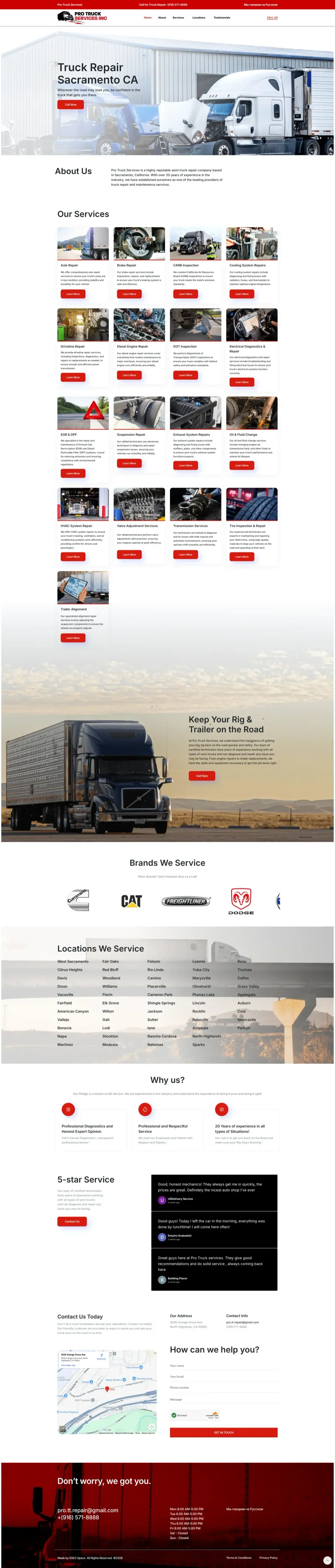
Website Design and Local SEO for Truck Repair in Sacramento, CA
0 to 31 organic keywords with multi-location visibility across Sacramento metro