



What is Keyword Research?
TL;DR
Finding out what your potential customers are already searching for, then building content that shows up when they search. Keyword research identifies which terms to target in your Search Engine Optimization strategy by analyzing search volume, competition, Search Intent, and relevance to your business. It forms the foundation for On-Page SEO content optimization and Content Strategy.
On this page
Why Keyword Research Matters
Keyword research is the foundation of every successful SEO strategy. Without it, you're creating content in the dark, hoping to stumble upon traffic.
It reveals actual demand. Search volume data shows you exactly how many people search for specific terms each month. This prevents you from investing resources in content nobody's looking for.
It uncovers intent. Keywords aren't just words. They represent problems people are trying to solve. "How to fix leaky faucet" signals someone ready for DIY instructions. "Plumber near me" signals someone ready to hire. Understanding this Search Intent determines what type of content to create.
It exposes opportunity gaps. Proper research reveals keywords your competitors rank for that you don't. These content gaps represent immediate opportunities to capture traffic you're currently losing.
It prioritizes your efforts. Not all keywords are worth pursuing. Research helps you identify which terms have realistic competition levels for your site's authority, which actually drive revenue (not just vanity traffic), and which align with what you want more of.
It prevents Content Cannibalization. When you map keywords to content before writing, you avoid creating multiple pages fighting each other for the same terms. This intentional structure builds Topical Authority instead of internal competition.
How Keyword Research Works
Effective keyword research follows a systematic process that moves from broad discovery to strategic prioritization.
Step 1: Seed keyword brainstorming. Start with your core topics. What problems do you solve? What do customers ask about? What would someone search to find your services? These seed keywords launch your research.
Step 2: Keyword expansion. Use tools to expand seed keywords into comprehensive lists. Ahrefs' Keyword Explorer, Semrush's Keyword Magic Tool, or Google's autocomplete suggestions reveal variations you'd never think of. A seed like "plumber" expands into hundreds of variations: "emergency plumber," "plumber cost," "how to find a good plumber."
Step 3: Metrics analysis. For each keyword, evaluate:
- Search volume: Monthly searches. Higher isn't always better because very high volume usually means very high competition.
- Keyword difficulty (KD): How hard to rank, based on competitor backlink profiles.
- CPC: Cost-per-click indicates commercial value. Advertisers pay more for keywords that convert.
- SERP features: What appears in results? Local packs, featured snippets, videos?
Step 4: Intent classification. Categorize keywords by Search Intent:
- Informational: "How to unclog drain" → Create how-to guides
- Commercial: "Best plumber in Denver" → Create comparison or service pages
- Transactional: "Hire plumber now" → Create conversion-focused landing pages
- Navigational: "Roto-Rooter phone number" → These typically target specific brands
Step 5: Competition analysis. Search each target keyword and analyze page-one results:
- What's their domain authority?
- What content format dominates (guides, lists, videos)?
- How comprehensive is their coverage?
- Can you create something meaningfully better?
Step 6: Keyword mapping. Assign keywords to specific pages. Each page should target one primary keyword and several semantically related secondary keywords. This prevents cannibalization and creates clear content briefs.
Step 7: Prioritization matrix. Score keywords across dimensions:
- Business relevance (1-5)
- Ranking difficulty (1-5)
- Conversion potential (1-5)
- Current ranking position (if any)
Focus first on high-relevance, low-difficulty keywords with commercial intent. These are your quick wins.
Keyword Research Approaches
| Type | Description | When to Use |
|---|---|---|
| Competitor-Led Research | Analyze what keywords competitors rank for, then target gaps and opportunities | Established markets with known competitors; quick way to find proven keywords |
| Topic-Led Research | Start with topics you want to own, then discover all related keyword variations | Building Topical Authority; comprehensive content clusters |
| Question-Led Research | Focus on questions your audience asks (using tools like AnswerThePublic, AlsoAsked) | FAQ content, featured snippet targeting, building trust through helpfulness |
| Customer-Led Research | Mine customer conversations, support tickets, reviews for actual language used | Discovering long-tail keywords competitors miss; authentic voice |
Keyword Research Best Practices
-
Start with low-difficulty keywords when building a new site. Targeting "plumber" (KD 90+) when you have 10 domain authority is a waste of time. Target "how to stop running toilet at night" (KD 20) to build momentum and authority first.
-
Look beyond search volume. A keyword with 50 monthly searches but high commercial intent (CPC $40+) often outperforms a keyword with 5,000 searches but no buying intent. Ten visitors who convert beat a thousand who bounce.
-
Group keywords into topic clusters. Don't create isolated pages. Build clusters where pillar content targets broad terms and supporting content targets long-tail variations. This signals Topical Authority to Google.
-
Analyze SERP features before committing. If a keyword's results are dominated by featured snippets, images, or videos, your traditional article may never get clicks even if it ranks. Match your content format to what Google already displays.
-
Update research quarterly. Search behavior changes. New competitors emerge. Algorithm updates shift rankings. Quarterly research keeps your strategy current and surfaces new opportunities.
-
Mine Google Search Console for hidden gems. You're already ranking for keywords you don't know about. Search Console shows impressions for terms where you rank positions 8-20. These are easy wins waiting for a content refresh.
-
Target the specific phrases giants ignore. Instead of fighting for "buy board games online" against Amazon, target "best 2-player cooperative strategy games under $40." Lower volume, higher intent, realistic competition. See our e-commerce SEO case study for how this worked in practice.
Common Keyword Research Mistakes to Avoid
-
Fighting battles you can't win. Targeting ultra-high volume keywords because they look impressive, ignoring that you'll never rank for them. Amazon has been building authority on "buy board games" for two decades. You're not going to outrank them. Find the niches they ignore instead.
-
Ignoring Search Intent. Creating a service page for an informational keyword, or a blog post for a transactional keyword. Google won't rank content that doesn't match what users want. Always check what currently ranks before creating anything.
-
One keyword per page thinking. Modern SEO is semantic. A page should target one primary keyword and many related terms that share the same intent. Obsessing over one exact phrase misses how search actually works.
-
Skipping competitor analysis. Assuming you can rank without checking what's currently winning. If page one is dominated by sites with 1,000+ referring domains and you have 20, you need a different keyword, not a better article.
-
Research without action. Building massive keyword spreadsheets that never become content. Research is worthless until it produces published, optimized pages. Set deadlines and execute.
-
Forgetting to map keywords to pages. Researching keywords without assigning them to specific URLs leads to Content Cannibalization: multiple pages competing for the same terms, weakening all of them.
Recommended Keyword Research Tools
Industry-standard for keyword research with accurate difficulty scores, SERP analysis, and the largest backlink database. Keywords Explorer shows traffic potential, not just search volume.
Comprehensive keyword database with Keyword Magic Tool for expansion, position tracking, and competitive analysis. Excellent for comparing your keywords against competitors.
Free and essential. Shows actual keywords driving impressions and clicks to your site. Invaluable for finding ranking opportunities in positions 5-20 where optimization could push you higher.
Free with Google Ads account. Best for discovering commercial keywords and understanding CPC values. Volume ranges are approximate but useful for directional research.
Visualizes People Also Ask questions as a tree structure. Perfect for understanding related questions and building comprehensive content that answers the full scope of user queries.
Frequently Asked Questions About Keyword Research
How often should I do keyword research?
Comprehensive research when launching new sites or major initiatives. Quarterly reviews to catch emerging trends and competitive shifts. Monthly check-ins on Search Console data to find quick-win opportunities in positions 8-20 where you're already showing up.
What's a good keyword difficulty score to target?
It depends on your site's authority. New sites (DR under 20) should target KD 0-20. Growing sites (DR 20-40) can pursue KD 20-40. Established sites (DR 40+) can compete for tougher terms. But don't trust KD numbers blindly. Always check who actually ranks for the term and compare their authority to yours.
Should I target short-tail or long-tail keywords?
Both, strategically. Long-tail keywords (3+ words) are easier to rank for and often convert better because the searcher knows exactly what they want. Use them to build authority and traffic. Short-tail keywords (1-2 words) drive volume but are competitive. Target those with pillar content after you've established [[topical-authority]] through long-tail wins.
How many keywords should I target per page?
One primary keyword that defines the page's main topic, plus 5-15 semantically related secondary keywords that share the same intent. Don't stuff unrelated terms. A well-written page naturally ranks for dozens of variations because Google understands topics, not just exact matches.
Is keyword research different for local businesses?
Yes. [[local-seo]] keyword research requires location modifiers and understanding of the [[local-pack]]. Target '[service] + [city]' patterns, 'near me' variations, and neighborhood-specific terms. For local searches, Google Business Profile optimization often matters more than traditional page-one rankings.
What if I've done keyword research before and it didn't work?
Usually one of two problems: either the keywords targeted had impossible competition, or the keywords had traffic but no buying intent. Research that works starts with what calls you actually want, not what keywords have the highest volume. Rankings that don't turn into business aren't worth having.
Terms Related to Keyword Research
Content Gap
A content gap is a topic, keyword, or question that your target audience searches for but your website doesn't address,...
Read definition SEOOn-Page SEO
The practice of optimizing individual web pages to rank higher in search results. On-page SEO focuses on both content an...
Read definition SEOSearch Engine Optimization
The practice of optimizing a website to improve its visibility and ranking in organic (non-paid) search engine results....
Read definition SEOSearch Intent
The purpose or goal behind a user's search query. Understanding search intent is critical for Keyword Research and On Pa...
Read definition SEOTopical Authority
Topical authority is Google's assessment of how deeply your website covers a specific subject area. A site with comprehe...
Read definition SEO301 Redirect
A permanent redirect that tells browsers and search engines "this page has moved forever, go here instead." When someone...
Read definitionFeatured SEO Case Study

Bot Image AI: Zero to 158 Keywords for FDA-Cleared Tech
Full website design for Bot Image, the company behind North America's first FDA-Cleared AI for prostate cancer screening. From zero web presence to 158 organic keywords with #1 positions for core product terms.
More SEO Case Studies

Ladies of Liberty: A Redesign That Matched the Mission's Energy
249 organic keywords and #1 rankings for core brand terms plus top-5 positions for high-search-volume speaker names

Website Design and Local SEO for Truck Repair in Sacramento, CA
0 to 31 organic keywords with multi-location visibility across Sacramento metro

Smarter Energy Services: Solar Design That Ranks #1 in Brooklyn
#1 for brand term, top 5 solar keyword positions, and $285/month organic traffic value

Website Design for Multifamily Renovation Contractor in Gardena
Professional B2B digital presence for a contractor with $1B+ in property acquisitions

Brand Identity for a San Antonio Art Marketplace
From zero brand to 250+ organic keywords and #1 rankings for San Antonio art searches

Safety Quest: How Design Drove 698 Keywords
698 organic keywords and #1 rankings for key security training terms
Struggling to rank? Let's fix that.
Let's talk about how seo can drive real growth for your business.
Get SEO HelpSEO Articles
View All Posts »
Mobile SEO Checklist: Fix Your Site Before Google Penalizes It
Google judges your website by its mobile version. If your site is slow, hard to read, or frustrating on a phone, you are being ranked on that experience. Here is how to fix it.

SEO Reporting Explained: What Your Reports Should (and Shouldn't) Show
Most SEO reports are designed to look impressive, not to tell you if SEO is making you money. Here is what a useful report actually includes, which metrics to ignore, and 5 questions to ask your agency.

SEO for Beginners: Where to Start When You Know Nothing
Starting from zero with SEO is overwhelming. There are hundreds of guides, tools, and opinions. Here is the actual order that works, from a 15-year practitioner who has helped businesses go from invisible to page one.

SEO Myths Debunked: 13 Things You've Been Told That Aren't True
I hear the same SEO myths every week on sales calls. Keyword stuffing, guaranteed rankings, SEO is dead. Here are 13 myths that cost small businesses real money, and the truth behind each one.
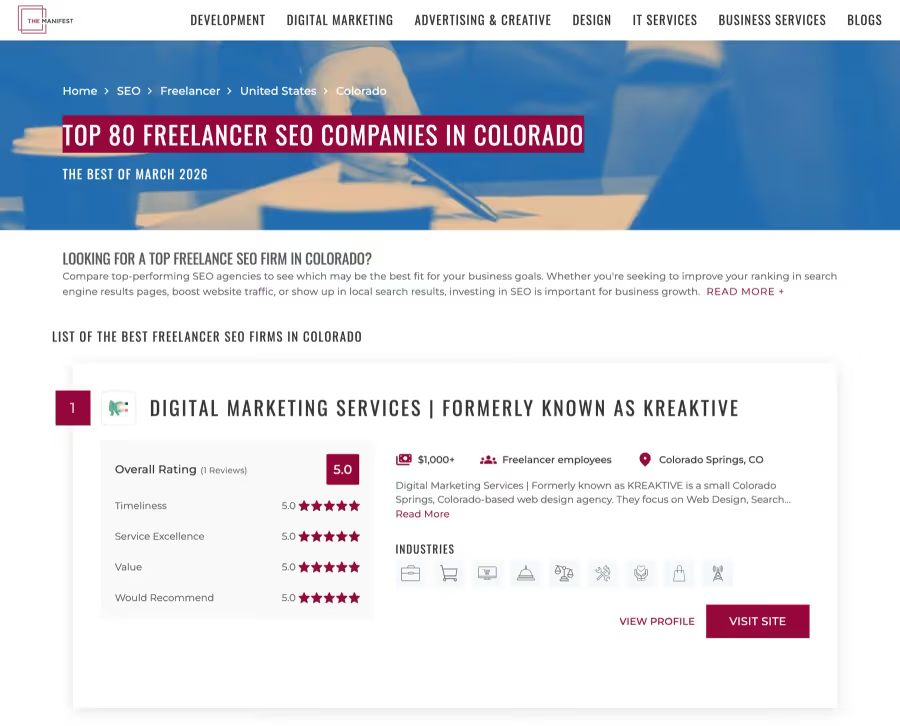
Best Freelance SEO Companies in Colorado: 2026 Clutch Rankings
Clutch ranks the top freelance SEO companies in Colorado based on verified client reviews. I reviewed the top agencies to help you pick the right one.

DMS Ranked #1 Across 4 Clutch Categories
Clutch, the leading B2B ratings platform, ranked Digital Marketing Services #1 in four freelance categories: Web Design, WordPress Design, Digital Strategy, and SEO in Colorado.
