



What is E-E-A-T?
TL;DR
E-E-A-T stands for Experience, Expertise, Authoritativeness, and Trustworthiness. It is Google's framework for evaluating content quality. It's not a direct ranking factor but guides how Google's algorithm assesses whether content deserves to rank. The "Experience" component (added in December 2022) emphasizes first-hand knowledge, making it harder for AI-generated or secondhand content to compete with content from people who've actually done the thing.
On this page
Why E-E-A-T Matters
Google processes billions of queries daily, and many lead users to content that could significantly impact their health, finances, or safety. E-E-A-T exists because Google needs a way to distinguish trustworthy sources from misleading ones.
For YMYL topics (Your Money or Your Life: health, finance, legal, news), E-E-A-T is critical. Google's Quality Rater Guidelines explicitly state that YMYL pages require high E-E-A-T to be considered high-quality.
For all other content, E-E-A-T still matters but the bar is lower. A recipe blog doesn't need medical credentials, but it should still show the author actually makes the recipes (experience) and knows about cooking (expertise).
The business impact: Sites demonstrating strong E-E-A-T tend to:
- Rank higher for competitive queries
- Recover faster from algorithm updates
- Convert better (trust signals help sales too)
- Get more backlinks (authoritative content attracts links)
How E-E-A-T Works
Google's algorithm doesn't directly measure "E-E-A-T score." Instead, it uses hundreds of signals that correlate with these qualities:
Experience signals:
- First-person language ("In my 10 years of plumbing...")
- Original photos and videos (not stock images)
- Specific details only someone with experience would know
- Case studies and real examples from your work
Expertise signals:
- Credentials and qualifications mentioned
- Technical depth and accuracy
- Comprehensive coverage of the topic
- Topical Authority from related content
Authoritativeness signals:
- backlinks from reputable sites in your industry
- Mentions and citations from authoritative sources
- Wikipedia references (for entities)
- Industry awards and recognition
Trustworthiness signals:
- HTTPS and security
- Clear contact information and physical address
- Privacy policy and terms of service
- Reviews and testimonials
- Accurate, well-sourced information
Google's Search Quality Raters (real humans) evaluate sites using these criteria. Their feedback trains the algorithm to recognize E-E-A-T signals automatically.
E-E-A-T Component Breakdown
| Type | Description | When to Use |
|---|---|---|
| Experience | First-hand involvement with the topic | Show you've actually done what you're writing about |
| Expertise | Knowledge and skill in the subject area | Demonstrate deep understanding through comprehensive content |
| Authoritativeness | Recognition as a go-to source | Build reputation through backlinks, mentions, citations |
| Trustworthiness | Accuracy, transparency, and reliability | Be honest, cite sources, secure your site |
E-E-A-T Best Practices
-
Add detailed author bios with credentials, experience, and photos. Link to LinkedIn profiles or professional pages. Don't use 'Admin' as your author name.
-
Show your work. Include original photos from projects, screenshots of results, case studies with real data. Stock photos signal inexperience.
-
Cite authoritative sources. Link to studies, official documentation, and industry standards. This demonstrates you've done research beyond your own knowledge.
-
Keep content updated. Outdated information (old statistics, deprecated practices) signals neglect. Add 'Last updated' dates and actually update the content.
-
Build a reputation beyond your website. Speak at conferences, contribute to industry publications, get quoted in news articles. These external signals validate your authority.
-
Be transparent about limitations. If you're not a doctor, don't give medical advice, or clearly state that readers should consult a professional.
Common E-E-A-T Mistakes to Avoid
-
Fake credentials or inflated expertise. Google and users will eventually catch this, and the penalty (algorithmic and reputational) is severe.
-
Using AI-generated content without human oversight. AI lacks experience by definition. Use it for research or drafts, but add your genuine expertise.
-
Hiding or omitting author information. Anonymous content lacks accountability. Even pen names should have consistent personas with visible expertise.
-
Ignoring technical trust signals like HTTPS, missing contact pages, or broken links. These erode trust even if content quality is high.
-
Over-focusing on word count instead of value. A 5,000-word article padded with fluff demonstrates less expertise than a concise 1,500-word guide that covers everything needed.
-
Neglecting off-site reputation. You can't build E-E-A-T in isolation. If your brand has no presence beyond your website, authority is limited.
Recommended E-E-A-T Tools
The official 170-page document Google uses to train quality raters. Essential reading for understanding E-E-A-T.
Content optimization tool that helps ensure comprehensive topic coverage, a key expertise signal.
Get quoted in news articles by responding to journalist queries. Builds authoritativeness through external mentions.
Structured data to explicitly connect content to author entities, helping Google understand who created what.
Frequently Asked Questions About E-E-A-T
Is E-E-A-T a ranking factor?
Not directly. Google doesn't have an 'E-E-A-T score' in its algorithm. Instead, E-E-A-T is the framework that describes what Google's algorithm tries to measure through hundreds of indirect signals. Sites that demonstrate E-E-A-T tend to have the signals that correlate with higher rankings.
How do I demonstrate 'Experience' as a company (not individual)?
Show company history and track record. Display years in business, number of projects completed, and case studies with real results. Feature employee expertise and credentials. Share behind-the-scenes content showing your team doing the work. Customer testimonials and reviews also validate that you've delivered for real people.
Does E-E-A-T matter for local businesses?
Yes, especially the Experience and Trustworthiness components. Local reviews on Google Business Profile are trust signals. Photos of your actual location, team, and work demonstrate experience. Professional certifications and licenses show expertise. For local service businesses, E-E-A-T often comes through reviews and visible proof of completed work.
Can new websites build E-E-A-T?
Yes, but it takes time. Start with content showcasing your genuine expertise. Feature the real people behind the business with their actual credentials. Build trust through transparency (contact info, policies). Authority comes last. Earn backlinks and mentions by creating linkable content and building industry relationships. Focus on depth in one topic area before expanding.
How did the 'Experience' addition in 2022 change things?
Before, a skilled researcher could write authoritative-seeming content without personal experience. Now, Google values first-hand knowledge: the plumber who's actually fixed 1,000 leaky faucets, the traveler who's actually been to Bali. This particularly impacts AI content and content farms, which lack genuine experience by definition.
Terms Related to E-E-A-T
Algorithm
The complex set of rules Google uses to rank websites. Google updates its algorithm thousands of times per year, with ma...
Read definition SEOThin Content
Thin content refers to pages that provide little to no unique value to users: short pages with minimal information, auto...
Read definition SEOTopical Authority
Topical authority is Google's assessment of how deeply your website covers a specific subject area. A site with comprehe...
Read definition IndustryYMYL
"Your Money or Your Life", Google's designation for content that could significantly impact health, finances, safety, or...
Read definition SEO301 Redirect
A permanent redirect that tells browsers and search engines "this page has moved forever, go here instead." When someone...
Read definition SEO302 Redirect
A temporary redirect that tells search engines "this page has moved for now, but it's coming back." Unlike a 301 Redirec...
Read definitionFeatured SEO Case Study

Bot Image AI: Zero to 158 Keywords for FDA-Cleared Tech
Full website design for Bot Image, the company behind North America's first FDA-Cleared AI for prostate cancer screening. From zero web presence to 158 organic keywords with #1 positions for core product terms.
More SEO Case Studies

Ladies of Liberty: A Redesign That Matched the Mission's Energy
249 organic keywords and #1 rankings for core brand terms plus top-5 positions for high-search-volume speaker names
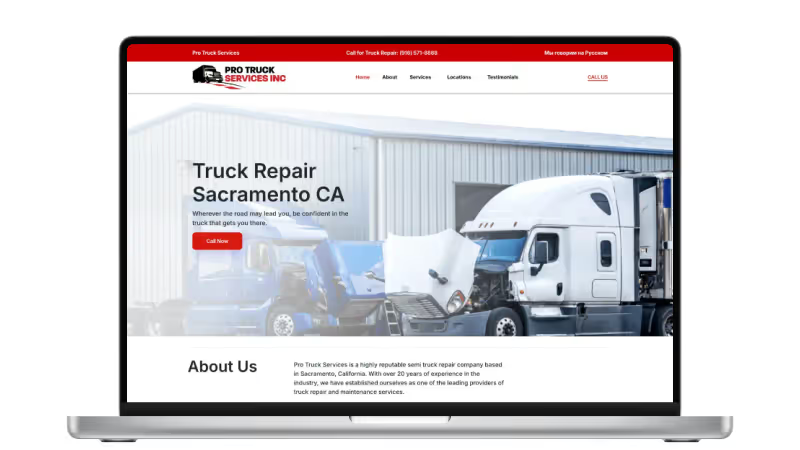
Website Design and Local SEO for Truck Repair in Sacramento, CA
0 to 31 organic keywords with multi-location visibility across Sacramento metro

Smarter Energy Services: Solar Design That Ranks #1 in Brooklyn
#1 for brand term, top 5 solar keyword positions, and $285/month organic traffic value

Website Design for Multifamily Renovation Contractor in Gardena
Professional B2B digital presence for a contractor with $1B+ in property acquisitions

Brand Identity for a San Antonio Art Marketplace
From zero brand to 250+ organic keywords and #1 rankings for San Antonio art searches
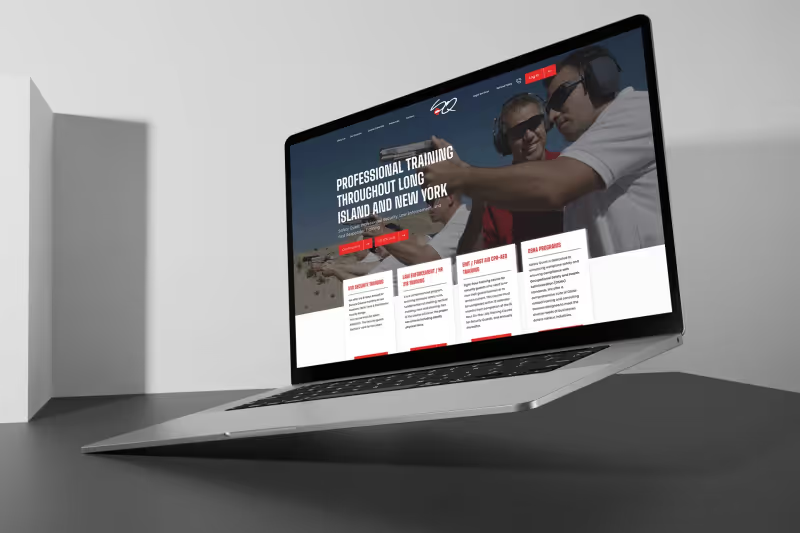
Safety Quest: How Design Drove 698 Keywords
698 organic keywords and #1 rankings for key security training terms
Struggling to rank? Let's fix that.
Let's talk about how seo can drive real growth for your business.
Get SEO HelpSEO Articles
View All Posts »
Mobile SEO Checklist: Fix Your Site Before Google Penalizes It
Google judges your website by its mobile version. If your site is slow, hard to read, or frustrating on a phone, you are being ranked on that experience. Here is how to fix it.

SEO Reporting Explained: What Your Reports Should (and Shouldn't) Show
Most SEO reports are designed to look impressive, not to tell you if SEO is making you money. Here is what a useful report actually includes, which metrics to ignore, and 5 questions to ask your agency.

SEO for Beginners: Where to Start When You Know Nothing
Starting from zero with SEO is overwhelming. There are hundreds of guides, tools, and opinions. Here is the actual order that works, from a 15-year practitioner who has helped businesses go from invisible to page one.

SEO Myths Debunked: 13 Things You've Been Told That Aren't True
I hear the same SEO myths every week on sales calls. Keyword stuffing, guaranteed rankings, SEO is dead. Here are 13 myths that cost small businesses real money, and the truth behind each one.
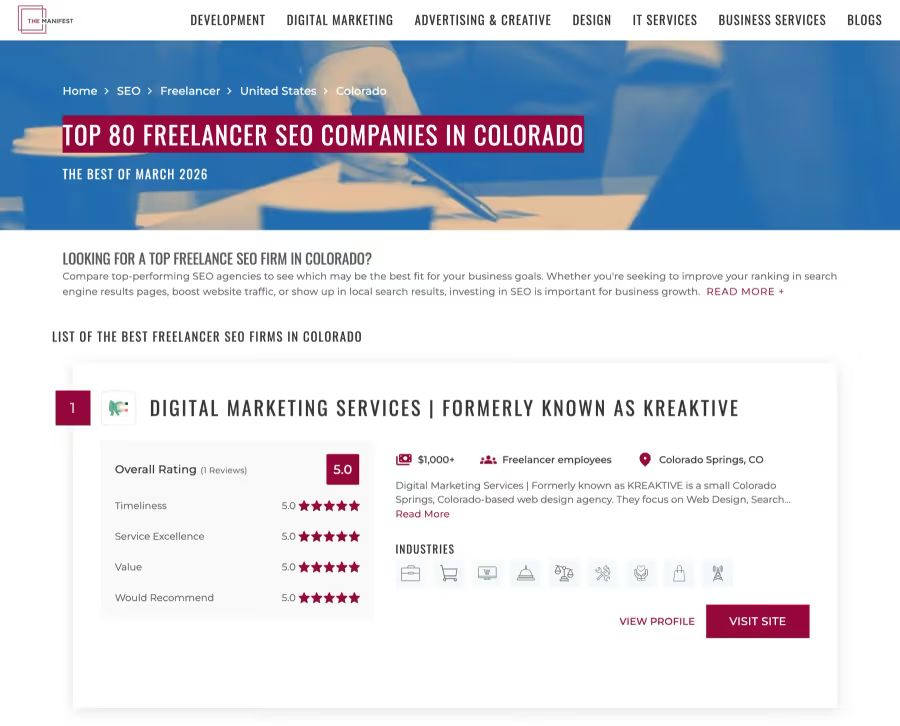
Best Freelance SEO Companies in Colorado: 2026 Clutch Rankings
Clutch ranks the top freelance SEO companies in Colorado based on verified client reviews. I reviewed the top agencies to help you pick the right one.

DMS Ranked #1 Across 4 Clutch Categories
Clutch, the leading B2B ratings platform, ranked Digital Marketing Services #1 in four freelance categories: Web Design, WordPress Design, Digital Strategy, and SEO in Colorado.
