



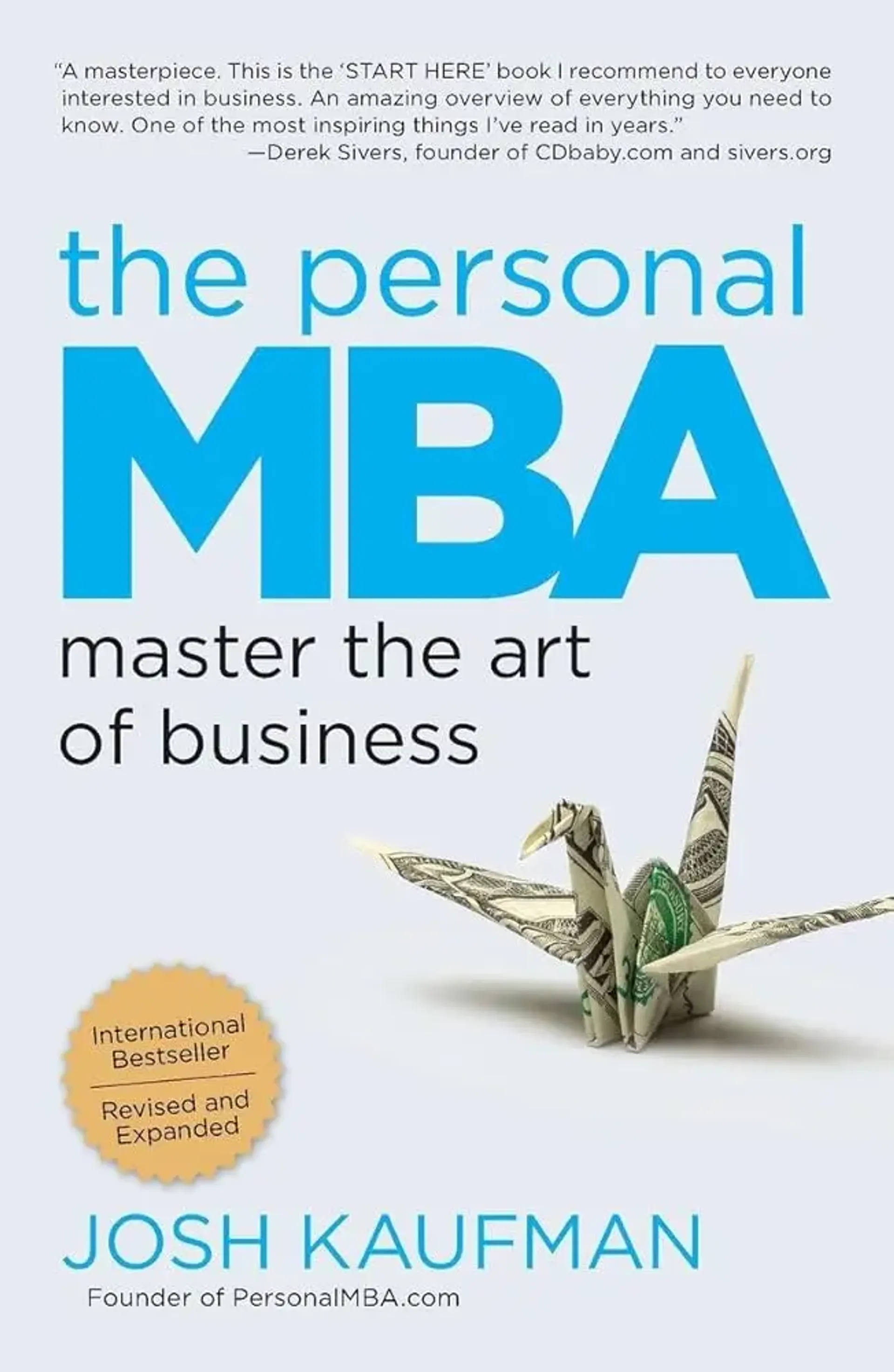
The Personal MBA Review: The Business Education I Actually Used to Build a #1 Agency
Josh Kaufman's The Personal MBA gave me the business operating system I didn't know I was missing. As a designer-turned-agency-owner, this book filled every blind spot.
On this page
The Designer Who Couldn’t Read a P&L
Five years into building DMS, I had a problem I couldn’t design my way out of.
I could build beautiful websites. I could craft brands that turned heads. But the actual business of running an agency? Pricing strategy, cash flow, understanding why some months were feast and others famine? I was winging it.
The worst part: I didn’t know what I didn’t know.
I’d never taken a business class. Never studied finance. I was a designer running a business on instinct and adrenaline.
Then I found Josh Kaufman’s The Personal MBA, and shortly after, enrolled in his CreativeLive class. It was 2016. What I learned in those sessions became the operating system my agency was missing.
The 5-Part Business System
Kaufman’s central idea is simple: every business runs on five interdependent parts.
- Value Creation: Discovering what people need and building it
- Marketing: Getting attention and building demand
- Sales: Turning prospects into paying customers
- Value Delivery: Giving customers what you promised
- Finance: Making sure the money works
That’s it. Every business, from a solo freelancer to a Fortune 500 company, runs on these five processes.
For someone coming from a creative background, this was a revelation. I’d been thinking about my business as “making things for clients.” Kaufman reframed it as an interconnected system where every part affects every other part.
Suddenly I could see why certain decisions rippled through the entire business.
Mental Models That Changed How I Operate
The Personal MBA isn’t really a book about business tactics. It’s a book about mental models: reusable thinking frameworks you can apply across domains. Kaufman covers roughly 250 of them.
Here are the ones that stuck:
Throughput
I used to measure success by how many projects I could take on. Kaufman flipped that. Throughput is the rate at which a system achieves its goal.
For an agency, that’s not “projects started.” It’s “projects completed profitably.” That single reframe made me stop overcommitting and start optimizing for finished, paid work.
Opportunity Cost
Every yes is a no to something else. I used to say yes to every project because more revenue felt like more success.
Understanding opportunity cost taught me that taking a $3K project means you can’t take the $15K project that shows up next week. This concept made me comfortable raising prices and turning away work that didn’t fit. It’s the same principle behind how I structure my SEO services and website design packages today.
Perceived Value vs. Economic Value
Kaufman separates what something is worth (economic value) from what people believe it’s worth (perceived value).
As a designer, I intuitively understood perceived value. That’s what branding is. But I’d never connected it to my own pricing. This framework, combined with what I later learned from $100M Offers, became the foundation for how I package and price my services today.
Iteration Cycles
Speed of learning beats quality of planning. Kaufman’s emphasis on fast iteration gave me permission to launch imperfect offerings and improve based on real feedback.
Before this book, I’d spend months perfecting a service package before testing it. Now I ship in weeks and iterate based on what clients actually respond to.
What Changed at DMS
The shift wasn’t overnight. But over the following year, three things changed in ways I didn’t expect.
1. I stopped thinking like a freelancer.
Instead of “what project should I work on today,” I started asking “which of the five business systems needs attention?” Some weeks that was marketing. Some weeks it was finance. The bird’s-eye view changed everything.
2. I restructured pricing around value, not hours.
Understanding economic vs. perceived value, plus concepts like bundling and unbundling, gave me the vocabulary to move to value-based pricing. Hourly billing died that year.
3. I started making decisions with frameworks, not gut feelings.
Opportunity cost. Sunk cost fallacy. Marginal utility. These aren’t academic concepts. They’re daily tools. When a client wants to add scope, I run it through opportunity cost. When I’m evaluating a new tool, I think about marginal returns.
These weren’t dramatic pivots. They were quiet upgrades to how I think about the business. Compounded over a decade, they’re a significant part of why DMS is the #1 agency in Colorado today.
The Honest Downside
Let me be straight: The Personal MBA is a mile wide and an inch deep.
It covers 250+ concepts across five business domains. Each one gets maybe two pages. If you want deep expertise in marketing, read They Ask You Answer. For pricing mastery, read $100M Offers. For messaging frameworks, read Building a StoryBrand.
But here’s why I still rate it 5 stars:
If you don’t know what you don’t know, depth is useless. You need the map first.
Coming from a pure creative background, the breadth was the entire point. I didn’t need a 400-page book on finance. I needed someone to explain what a P&L statement is, why cash flow matters, and how to think about it. Ten clear pages. Then I could go deeper where it mattered.
The Personal MBA gives you the complete map. The other books in this series give you the turn-by-turn directions.
Where It Fits in Your Reading
This is Part 4 of my Essential Marketing Books series, but it works at any point in the sequence:
- StoryBrand: How to message (make your customer the hero)
- $100M Offers: How to package (create irresistible value)
- They Ask, You Answer: How to attract (build trust through content)
- The Personal MBA: How to think (see business as a system)
Read it first as the foundation, or last as the integrator. Kaufman’s 5-part system is the canvas. The other three books paint specific sections of it.
Who Should Read This
- Creative professionals running their own business (designers, developers, photographers, writers)
- Self-taught entrepreneurs who feel like they’re missing something fundamental
- Anyone who’s great at their craft but struggles with the business side
- Early-stage founders who want a complete mental model before diving into tactics
If you’ve ever felt like everyone else got a playbook for running a business and you didn’t, this is that playbook.
The Bottom Line
The Personal MBA didn’t teach me one killer framework. It gave me an operating system: a way to see, diagnose, and improve every part of my business.
For a designer who’d been running an agency on instinct and caffeine, that was everything.
Rating: 5/5. The business education I actually used. Not the deepest book on any one topic, but the most complete map of all of them. Just read it.
Frequently Asked Questions
If you're running a business without a formal business education, absolutely. It gives you the complete mental map of how businesses work, from value creation to finance, in language anyone can understand.
Josh Kaufman distills the core concepts of business into mental models organized around 5 areas: value creation, marketing, sales, value delivery, and finance. It's essentially an MBA curriculum compressed into practical, actionable frameworks.
It can't replace the network and credential of a top MBA program. But for practical business knowledge (especially for founders and creative professionals), it covers the same concepts at a fraction of the cost and time.
Founders without business backgrounds, creative professionals running their own businesses, and anyone who wants a structured mental model for how businesses actually work. It's particularly powerful for people who 'don't know what they don't know' about business.